Habit Formation: What the 2026 Research Actually Shows

Habit formation is the process by which a behavior you repeat in a consistent context stops requiring a decision and starts running on its own. The repetition moves control of that behavior out of deliberate, goal-directed processing and into automatic, cue-driven processing deep in the brain. Most advice about it is built on two numbers that are either wrong or badly out of date, so this guide uses the current evidence: a 2024 systematic review of 20 studies for the human timeline, and a 2026 Nature Communications paper for the mechanism. Our roundup of what the habit research actually says pulls the wider literature into one place.
How Do Habits Form in the Brain?
Habits form through repetition in a consistent context, which gradually moves control of a behavior from the deliberating parts of the brain to the basal ganglia, a set of structures that handle procedural learning and automatic action. The basal ganglia compress a repeated sequence into a single chunk that one cue can launch, so the behavior stops costing you a decision. The system is indifferent to whether the behavior is good for you; it automates whatever you repeat in the same place at the same time, which is why bad habits are built by exactly the same process as good ones.
The Basal Ganglia: Your Brain's Habit Engine
Habits don't live in the prefrontal cortex (the thinking, deliberating part of your brain). They live in the basal ganglia, a cluster of structures deep in the brain associated with procedural learning, pattern recognition, and automatic behavior.
When you repeat a behavior consistently in the same context, your brain gradually shifts control of that behavior from conscious to automatic processing. The basal ganglia "chunking" process compresses a sequence of actions into a single trigger-response unit, what researchers call a habit.
This is efficient. Once a behavior is chunked, your brain can run it with minimal metabolic cost. That's why you can drive a familiar route while thinking about something else entirely.
The downside: the basal ganglia doesn't distinguish between good habits and bad ones. It automates whatever you repeat consistently. This is why bad habits are so hard to break. They have stopped being decisions and become automated responses.
Do Habits Form Gradually or Suddenly?
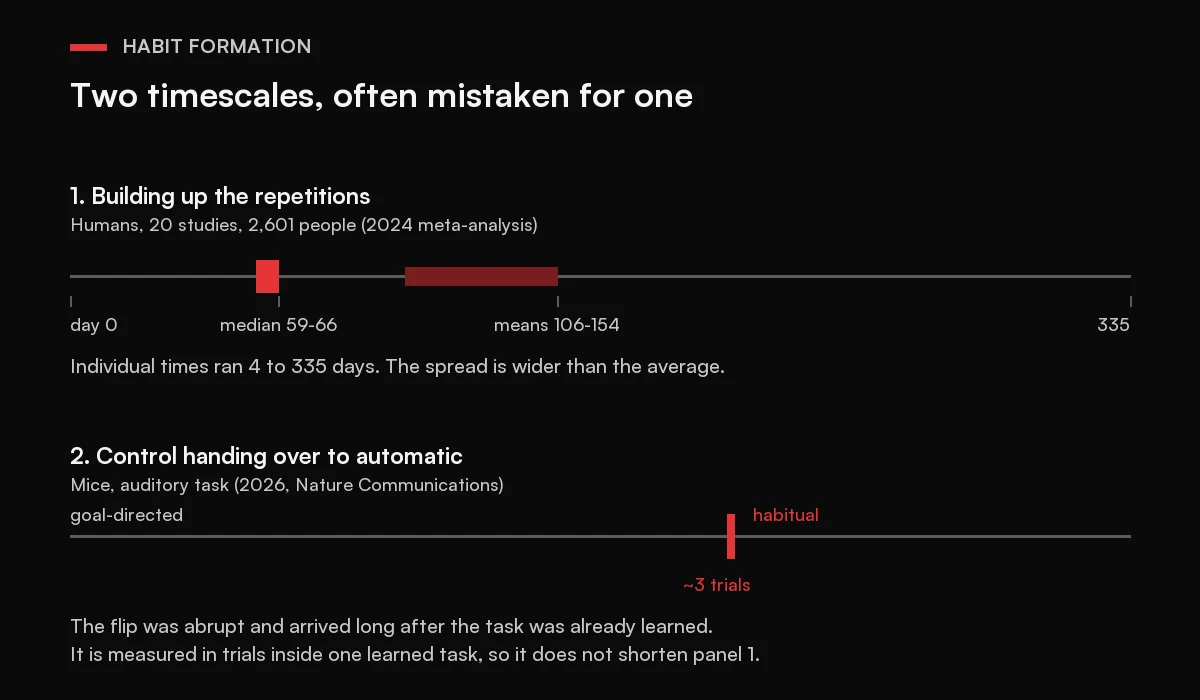
Both, on two different timescales, and conflating them is where most of the confusion about habit formation comes from.
Accumulating enough repetitions is slow. That is the part measured in weeks and months, and the numbers are in the next section. But the moment control actually hands over to the automatic system looks abrupt. A 2026 study in Nature Communications (Moore and colleagues, Johns Hopkins) trained mice on an auditory task and used statistical modelling to find the exact point where behavior became habitual. The transition took about three trials, and it happened long after the animals had already learned the task. Recordings showed a matching sudden change in the dorsolateral striatum: activity tied to the outcome dropped away and activity tied to the stimulus sharpened. The authors read it as a switch recruiting a habit circuit that was already available, rather than a gradual threshold being crossed.
Two limits matter and the paper states both. The study used mice; nothing in it was measured in a person. And "sudden" describes the handover inside a task the animal had already learned, measured in trials. The calendar time a person needs to build a new habit from scratch is a separate quantity. The headline that habits form faster than we thought is about the mechanism, and it does not shorten your two months.
One finding does carry over cleanly, and it is the useful one: some mice went back to goal-directed behavior after long habitual stretches. Automatic is a state a behavior sits in, and a behavior can come back out of it. That is the same thing habit relapse recovery describes from the human side.
This question is older than it looks. Clark Hull asked in 1943 whether habit formation was slow or sudden, and it took until 2026 to get a clean measurement.
The Habit Loop
The common formulation of a habit has three parts, and it maps onto the chunking that Ann Graybiel's lab at MIT described in the striatum:
- Cue (trigger): A context signal that tells the brain "this behavior is relevant now." Cues can be time-based (7am), location-based (walking into the gym), emotional (feeling stressed), or sequential (after brushing teeth).
- Routine (behavior): The actual behavior being automated.
- Reward: The neural signal that tells the brain this behavior was worth repeating. Dopamine is released in anticipation of the reward, not at receipt of it, which is why craving drives habit formation more than satisfaction does.
Understanding this loop is foundational to both building good habits and breaking bad ones. Changing a routine requires keeping the cue and reward the same while inserting a new behavior in between.
You will also see this written as the three R's: reminder, routine, reward. It is the same loop with friendlier labels, and it is a memory aid rather than a competing theory.
Neuroplasticity and Repetition
Habit formation is literally a physical change in your brain. Each repetition of a behavior strengthens the synaptic connections involved. The phrase "neurons that fire together wire together" (Hebb's rule) describes this exactly. Repeated co-activation of neural circuits makes those circuits more likely to activate together in the future.
This means habit formation requires repetition. There is no shortcut. The question is how to make repetition sustainable. This plasticity persists throughout life, which is why building habits after 40 is far more achievable than the "set in your ways" cliche suggests.
How Long Does Habit Formation Actually Take?
The number worth planning around comes from a 2024 systematic review and meta-analysis in Healthcare (Singh, Murphy, Maher and Smith), which searched six databases and pooled 20 studies covering 2,601 participants. The studies' mean ages ranged from 21.5 to 73.5, so the pooled evidence spans adults of every age rather than students alone.
Four of those studies reported a time to habit formation:
| Measure | Range reported |
|---|---|
| Median time to habit formation | 59 to 66 days |
| Mean time to habit formation | 106 to 154 days |
| Individual times observed | 4 to 335 days |
| Pooled change in habit strength, pre to post | SMD 0.69 (95% CI 0.49 to 0.88) |
Read it this way: about two months is a fair planning figure, and the spread from 4 to 335 days is the more important half. The gap between people is wider than the average, so a plan that assumes you are average is a plan with no margin in it.
Two caveats, both stated by the review's own authors. Only 20 studies met the criteria, and 11 of them were rated high risk of bias. Flossing and diet carry the most evidence; other behaviors carry less. This is the best available answer rather than a settled one.
The 66-day figure you have seen quoted everywhere traces to a single study by Phillippa Lally and colleagues, published in the European Journal of Social Psychology in 2010. The meta-analysis lands close to its median, which is reassuring for the original work and awkward for everyone who turned one study's median into a law. The 66-day habit myth article covers how that happened.
What Are the Stages of Habit Formation?
There are two useful ways to break this down, and they answer different questions.
The process framework. Lally and Gardner describe four stages: deciding to take action, translating that intention into behavior, repeating the behavior, and developing automaticity. Only the last one is specific to habits. The first three are what any behavior change requires, which explains a familiar pattern: people who are excellent at deciding and starting still end up with nothing automatic to show for it, because they never reached stage four.
The experiential stages. What the process feels like while you are inside it breaks down differently:
| Stage | Roughly when | What it feels like | Biggest risk |
|---|---|---|---|
| Initiation | The first week or two | Effortful, novel, motivating | Over-designing the habit |
| Learning | The long middle, typically weeks to months | Drag, friction, motivation drops | Quitting in the dropout gap |
| Stability | Once the behavior runs without deciding | Automatic, low effort | Boredom, complacency |
The stages are deliberately described by what they feel like instead of by day counts. With individual times running from 4 to 335 days, any day band precise enough to print is wrong for most people reading it.
Stage 1: Initiation
The behavior feels effortful and deliberate. You have to consciously choose to do it. Motivation is typically high in this stage because the behavior is new and interesting.
The most common mistake in Stage 1 is over-designing the habit. People start with a complex routine that requires perfect conditions. When conditions are not perfect, the habit breaks.
Strategy: Make the behavior as small as possible. The two-minute rule, starting with a version of the habit that takes two minutes or less, removes the activation energy barrier during Stage 1.
Stage 2: Learning
The behavior is becoming more automatic, but it still requires intentional maintenance. This is the danger zone. Motivation drops, novelty fades, and competing priorities emerge.
This is the stage the timeline numbers are really about. If the median is 59 to 66 days, almost all of that time is spent here, doing the behavior while it still feels like work.
Strategy: Environment design matters most in Stage 2. Reduce friction for your desired habit (put running shoes by the door) and increase friction for competing behaviors. Your environment does the remembering for you. See environment design for habits for a full breakdown.
Stage 3: Stability
The behavior has become automatic. You do it without significant deliberation. Missing one day doesn't derail the habit permanently, since the neural pathway is established enough to recover.
Many people never reach Stage 3 because they quit during Stage 2's friction. The key insight: the difficulty you feel in weeks 2 to 4 is the automation process running, and it is what progress feels like from the inside.
Stability is also not permanent. The 2026 mouse work found animals reverting to goal-directed control after long habitual periods, and anyone who has rebuilt a gym habit after a holiday has felt the human version.
What Actually Changes How Fast a Habit Forms?
This is the part of the 2024 meta-analysis that nobody quotes, and it is the most useful part. Alongside the timeline, the review identified the factors that significantly influenced habit strength across the pooled studies:
- Timing. Habits practised at a consistent time formed more strongly, and morning practices generally showed greater strength than habits slotted in later.
- Frequency. How often the behavior was repeated significantly affected habit strength. The review does not publish an optimal number per week, so treat it as a reason to favour the more frequent version of a behavior when both are acceptable.
- Individual choice. Self-selected habits showed greater strength than habits assigned to someone. A habit somebody else picked for you is working against you from day one.
- Affective judgements. Whether you expect the behavior to feel good predicts whether it sticks. It is a good argument for temptation bundling over grinding out something you hate.
- Behavioural regulation. Self-monitoring and planning capacity, the skills implementation intentions train.
- Preparatory habits. The small habit before the habit. Laying out kit the night before is itself a behavior that automates, and it carries the main one.
- Type of habit. Which behavior it is mattered. The review's strongest evidence sits with flossing and diet, and it does not rank behaviors by how quickly they automate.
Four of those seven are settled before your first repetition: when you do it, how often, whether you picked it yourself, and which behavior it is. The review reports which determinants were significant and leaves them unranked, so treat this as a point about timing rather than importance. Those four are the ones you can still change for free, and only until you start.
Why Do Most Habit Attempts Fail?
Most habit attempts fail for one of five reasons, and all five happen before the behavior ever gets the chance to automate: the habit was designed too big to survive a bad day, it was left dependent on motivation that fluctuates, it was never attached to a reliable cue, there was no plan for what happens after a missed day, or the behavior never produced a reward the brain could register. Each one is a design fault in the plan, which means each one is fixable in advance. Here they are in the order they usually bite, with the research on why habits fail over the long term:
1. Starting Too Big
"I'll go to the gym for 90 minutes, 5 days a week" from zero exercise is a sprint dressed up as a habit plan. The behavior requires too much energy to be sustainable. When life intrudes (it always does), the habit breaks.
Smaller is more sustainable. A micro-habit, one pushup, one page of a book, 5 minutes of meditation, creates the repetition needed for automation without overwhelming your daily bandwidth.
2. Relying on Motivation
Motivation fluctuates. A behavior that only happens when you feel motivated is an occasional activity. The goal of habit formation is to reach automaticity so the behavior happens regardless of motivation level.
This is why systems beat motivation. Building habits without willpower focuses on designing your environment so the default behavior is the one you want.
3. No Cue Attachment
Habits need consistent cues. "I'll meditate when I feel like it" has no cue. There is nothing triggering the routine. Implementation intentions, "I will meditate at 7am after making coffee," specify both the cue and the routine, dramatically improving follow-through.
Peter Gollwitzer's work on implementation intentions is the most replicated result in this whole area, and its finding is simple: naming the when and the where in advance raises follow-through well above a general intention to do the thing. Read more: Implementation Intentions Guide.
4. Skipping Recovery Planning
Missing a day triggers what researchers call the "what-the-hell effect," the cognitive pattern of "I've already broken it, so I might as well quit." A single miss is survivable. The pattern that ends habits is the second miss arriving because the first one was reframed as failure.
A recovery protocol prevents the second miss from becoming permanent. See habit relapse recovery for the research-backed protocol.
5. Wrong Reward Loop
If you don't actually experience a reward after the behavior, the habit loop won't close. This is why habits tied to intrinsic rewards (curiosity, enjoyment, genuine benefit) last longer than those driven by external pressure. The meta-analysis finding on affective judgements says the same thing from the data side.
Reward schedules matter too. Variable rewards are more powerful than fixed rewards for maintaining behavior over time.
What Are the Evidence-Based Strategies for Habit Formation?
The strategies with the most support behind them all do the same job in different ways: they remove the need to decide. Habit stacking borrows a cue from a habit you already have. Implementation intentions fix the when and the where in advance. Identity framing changes what the behavior means. Temptation bundling attaches a reward you actually want. Streak marking makes stopping feel costly. None of them makes the behavior easier to perform. They make it harder to skip, which is the part that decides whether you reach automaticity.
Habit Stacking
Attaching a new habit to an established one: "After I pour my morning coffee, I will write in my journal for 5 minutes." The established behavior (coffee) becomes the cue for the new one.
Habit stacking is effective because it piggybacks on existing neural pathways instead of building entirely new ones. The existing habit provides both the cue and the contextual memory signal.
Identity-Based Framing
Define the habit by who it makes you. "I am a runner" does different work from "I want to run more." Identity-based framing turns the habit into a form of self-expression.
Research in self-concept theory supports this. When a behavior aligns with your self-concept, you're more likely to persist through difficulty. Full breakdown: Identity-Based Habits.
Keystone Habits
Certain habits have outsized positive spillover effects on other behaviors. Regular exercise is the most-cited example, with reported associations to sleep, food choices and productivity even when none of those was the target behavior. The direction of causation in that literature is rarely established.
Starting with a keystone habit creates positive cascades. See keystone habits examples for the research and a list of starting points that cascade.
Temptation Bundling
Pairing a behavior you need to do (exercise) with something you want to do (favorite podcast, TV show). The "want" becomes the reward for the "need," closing the habit loop in a way that feels good.
The approach comes out of Katherine Milkman's work at Wharton, where gym attendance rose for people who could only hear an audiobook they wanted while exercising. The published effect faded over the course of that trial, so treat it as a real but decaying lever. Temptation bundling works best when the pairing is exclusive. You only get the want when doing the need.
The Seinfeld Method
Marking each day's successful completion on a calendar. The visual chain of marks creates a meta-habit, maintaining the streak. The chain creates what psychologists call a "commitment device," a structure that makes breaking the habit feel more costly than continuing. Our deep dive on the psychology of habit streaks covers why this works at a neurological level.
The Seinfeld Strategy is most effective for daily habits with clear yes/no completion.
Which Habits Are Most Worth Forming?
Some habits carry far more than others. Keystone habits, the ones that set off positive cascades, are worth starting with. The starting points below are the ones most commonly proposed in the behaviour-change literature. Read the cascade column as the claimed association, which is correlational in nearly every case:
| Habit | Primary benefit | Cascade effects |
|---|---|---|
| Regular exercise | Physical health | Sleep quality, mood, cognitive function |
| Consistent sleep schedule | Recovery, cognition | Willpower, emotional regulation |
| Daily journaling | Self-awareness | Stress processing, goal clarity |
| Reading (30 min/day) | Knowledge accumulation | Vocabulary, focus capacity |
| Weekly planning session | Productivity | Reduces decision fatigue, improves goal follow-through |
| Meditation (10 min/day) | Stress reduction | Impulse control, emotional stability |
The compound effect of stacking these cascading habits over months and years is significant, far more than any single behavioral intervention.
Tracking and Accountability
Self-monitoring is one of the most consistently supported habit-formation tools in behavioral research. Logging your behavior creates awareness, a data record for reflection, and mild accountability to yourself. The 2024 meta-analysis puts behavioural regulation, which includes self-monitoring, among the determinants that significantly affect habit strength.
Adding external accountability on top of self-tracking is well supported in the behaviour-change literature, though the size of the effect varies by study and by how the accountability is delivered. For the full system view, see our accountability systems guide and our breakdown of commitment devices that work.
Two of the determinants above are scheduling problems rather than willpower problems: consistent timing and repetition frequency. FineStreak is built around that. You choose a goal, a check-in time and a rhythm, and an Agent calls or texts at the time you set and verifies what you did with a photo, a screenshot or your location. The research names the stable cue as the lever. A contact arriving at the same time is one way to hold it steady while the behavior is still in the learning stage.
Frequently Asked Questions
What is habit formation?▾
Habit formation is the process by which a behavior repeated in a consistent context stops requiring a decision and starts running automatically. The repetition shifts control of the behavior from deliberate, goal-directed processing to automatic, cue-driven processing in the striatum. Psychologists measure how far along that process a behavior is with automaticity scales such as the Self-Report Habit Index rather than by counting days.
How long does it take to form a habit?▾
The best current estimate comes from a 2024 systematic review and meta-analysis of 20 studies and 2,601 people (Singh et al., Healthcare). Of the four studies that reported a time to habit formation, medians ran 59 to 66 days and means ran 106 to 154 days, with individual times spanning 4 to 335 days. Treat two months as a reasonable planning figure and the spread as the real story, because the variation between people is larger than the average.
What are the four stages of habit formation?▾
Lally and Gardner's framework describes four stages: deciding to take action, translating that intention into actual behavior, repeating the behavior, and developing automaticity. Only the fourth stage is unique to habit formation. The first three are common to any behavior change, which is why people who are good at starting things still end up with nothing automatic to show for it.
What are the three R's of habit formation?▾
The three R's are reminder, routine and reward: a trigger that tells the brain the behavior is relevant now, the behavior itself, and a signal that it was worth repeating. It is a popular restatement of the cue, routine and reward loop described in the striatal habit research. The labels are a memory aid rather than a separate theory.
What is the 3-3-3 rule for habits?▾
There is no single 3-3-3 rule. A search for it returns at least five incompatible versions: three movement types done three times a week, three non-negotiable actions plus three minutes of effort plus three wins to review at night, three phased stages, 3 days then 3 weeks then 3 months, and an eating, hydration and movement rule sold for weight loss. None of them traces back to habit research. The variables that do have evidence behind them are cue consistency, repetition frequency and timing.
Do habits form gradually or suddenly?▾
Both, on two different timescales. Accumulating enough repetitions takes humans weeks or months. The moment control hands over to the automatic system may be abrupt: a 2026 Nature Communications study in mice (Moore et al.) found the switch from goal-directed to habitual behavior happened across roughly three trials, long after the animals had already learned the task, with a matching sudden shift in dorsolateral striatum activity. The study is in mice and it measures trials inside a learned task, so it does not mean a person needs fewer days.
Is the 21-day habit rule real?▾
No. The 21-day figure comes from Maxwell Maltz's 1960 book Psycho-Cybernetics, where it described how long plastic surgery patients took to adjust to their appearance. The 2024 systematic review names it as a popular-culture idea rather than a research finding, and puts the measured medians at 59 to 66 days with individual times anywhere from 4 to 335 days.

The mechanism, pointed at your Tuesday.
Knowing why habits fail changes nothing on its own. FineStreak puts a check-in on the calendar, asks for proof, and applies the consequence you chose. Free for 7 days, no card.
Put it into practiceRelated Articles

Habit Formation Research: What the Science Actually Says
A research-backed look at habit formation. Real studies, real timelines, and what neuroscience says about how your brain builds automatic behaviors.

The 66-Day Habit Myth: How Long Does It Really Take to Form a Habit?
The 66-day habit rule and the 21-day habit myth are both wrong. Here is what behavioral research actually says about how long it takes to form a habit.
Cue, Routine, Reward: How the Habit Loop Actually Works
Cue, routine, reward is the habit loop. Here is what the neuroscience actually shows, where the popular version overstates it, and how to use the loop yourself.

Habit Relapse Recovery: A 5-Step Bounce-Back Plan (2026)
Broke your streak? Run the 5-step bounce-back protocol, beat the abstinence violation effect, and use the never-miss-twice rule to rebuild momentum fast.