How to Break Bad Habits: 5-Step Science Framework

TL;DR: Breaking a bad habit requires finding the cue, swapping the routine while keeping the reward, redesigning your environment, and adding outside accountability that costs something real when you quit. It takes an average of 66 days, not 21, and willpower alone fails roughly 90% of the time.
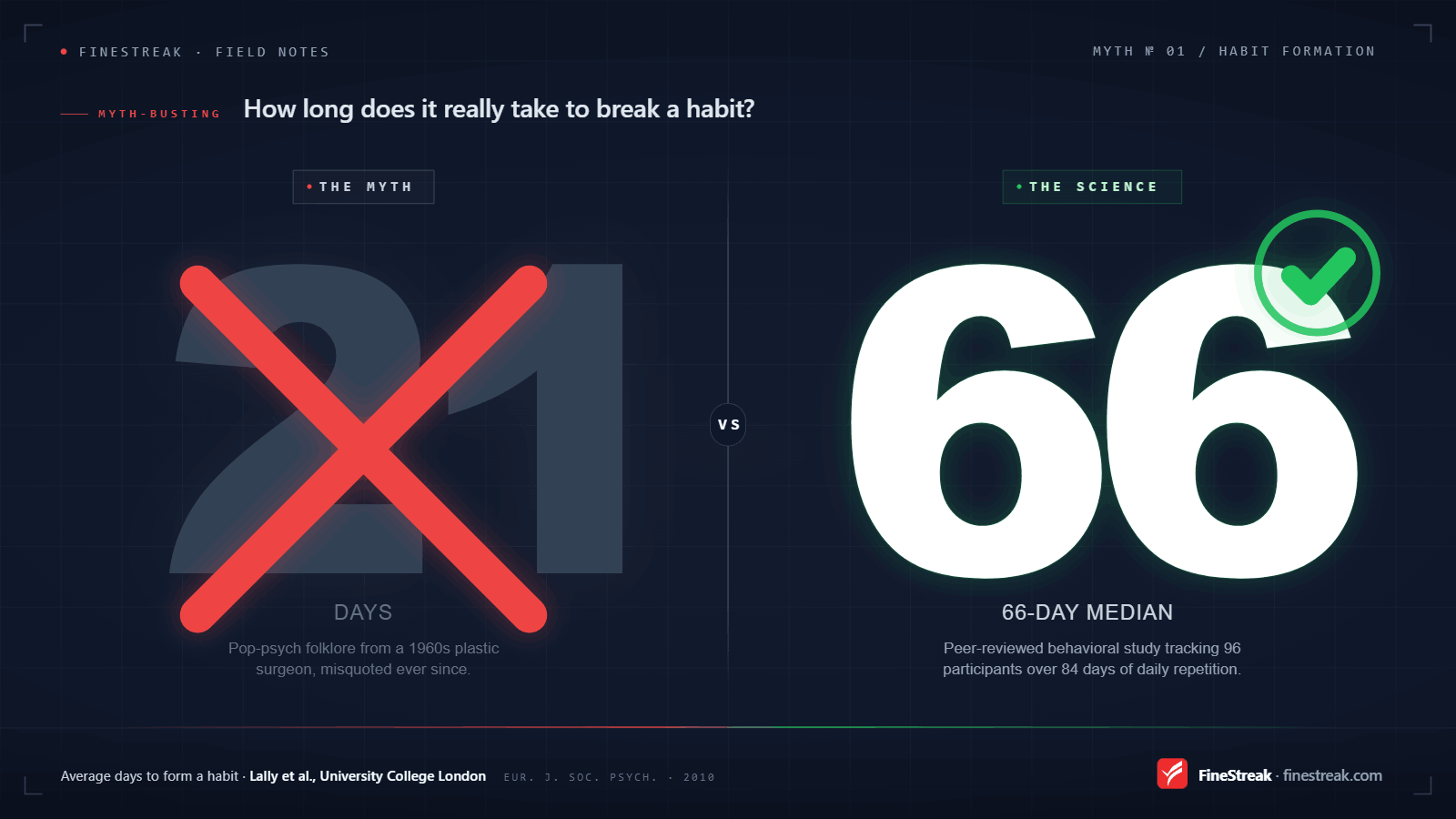
In 1960, a plastic surgeon named Maxwell Maltz published a book called Psycho-Cybernetics. He noticed his patients seemed to take about 21 days to get used to their new faces. He wrote it down as an observation. The self-help industry turned it into gospel.
That is where the 21-day myth came from. A guess. From a surgeon. Watching noses.
The real number, according to a 2010 study by Lally and colleagues at University College London, is anywhere from 18 to 254 days. The average is 66. Which means if you have been trying to quit scrolling, snacking, or snapping at your partner for three weeks and feel like a failure, you are not. You are on schedule.
Here is the framework that actually works.
Step 1: What Is the Habit Loop?
Charles Duhigg popularized this in The Power of Habit, but the clinical roots go back to Nathan Azrin habit reversal training, which is still used to treat smoking, gambling, anxiety, and OCD.
Every habit, good or bad, runs on the same three-part engine.
The habit loop:
- Cue: The trigger (stress, boredom, a time of day, a specific location)
- Routine: The behavior you want to change
- Reward: The craving being satisfied
Most people try to attack the routine directly. They white-knuckle it. They tell themselves to "just stop." That almost never works, because the cue keeps firing and the reward keeps calling. That pull is not weakness; it is dopamine responding to the cue, and the neuroscience of craving explains why the urge peaks before it fades.
Before you change anything, write the loop down. What happened right before the behavior? What did you get out of it? Be honest. If you do not know the reward, you cannot swap the routine.
How Different Methods Compare
Not all approaches are equal. Here is how the most common habit-breaking methods stack up against each other.
| Method | Avg Success Rate | Core Mechanism | Biggest Risk |
|---|---|---|---|
| Willpower alone | ~10% | Conscious suppression | Fails under stress and fatigue |
| Cold turkey | ~15% | Complete abstinence | Reward craving remains unsatisfied |
| 21-day countdown | ~20% | Fixed timeframe (fictional) | Too short for most habits |
| Habit reversal training | ~50-65% | Cue stays, routine swaps | Requires honest self-audit |
| Environment redesign | ~55-60% | Removes the cue entirely | Does not address the reward |
| Financial commitment contract | ~70-80% | Loss aversion as motivation | Requires financial buy-in |
| Combined approach (all five steps) | Highest | Stacks every mechanism | Requires upfront setup |
The methods with the highest success rates share one thing: they do not fight the brain. They work with the architecture already running.
Step 2: How Do You Audit Your Cue?
Marcus was reaching for his phone every time he sat down to watch TV. He thought the problem was the phone. The problem was the couch.
The couch was the cue. TV was the cue. The phone was the routine. The reward was the little dopamine hit that filled the silence between scenes.
Spend three days playing detective on yourself. Each time the bad habit fires, note five things: where you are, what time it is, who you are with, what you were just doing, and how you were feeling. Patterns will jump out fast.
40% of what you do today is not a decision. It is a habit firing automatically. Willpower will not beat that. Your environment will.
That stat is from Wendy Wood work at Duke University. Forty percent of your daily actions are not conscious. They are your autopilot running scripts. The only way to change the script is to find the trigger that launches it.
Step 3: How Do You Swap the Routine?
Here is where most advice goes wrong. It tells you to delete the reward. Do not.
The reward is what your brain actually wants. If you try to kill it, your brain will claw its way back to the old routine the moment you are tired, stressed, or overwhelmed. Instead, you keep the cue and the reward, and you swap the routine in between.
If the cue is "I feel lonely at 9pm" and the reward is "I feel connected," the routine does not have to be Instagram. It can be texting a friend. Calling your mom. Reading a novel with a character you love. Same cue. Same reward. Different behavior.
This is the core insight behind habit reversal training, which has been used clinically for decades on problems far harder than yours. It works because it does not fight the brain. It negotiates with it. CBT techniques for habit change work the same territory from the thought side, targeting the mental script that fires before the routine does.
Write out the swap in one sentence: "When I feel X, instead of Y, I will Z." Put it somewhere you will see it. If you want to go deeper on the flip side of this work, see our guide on building better habits.
Step 4: Change Your Environment
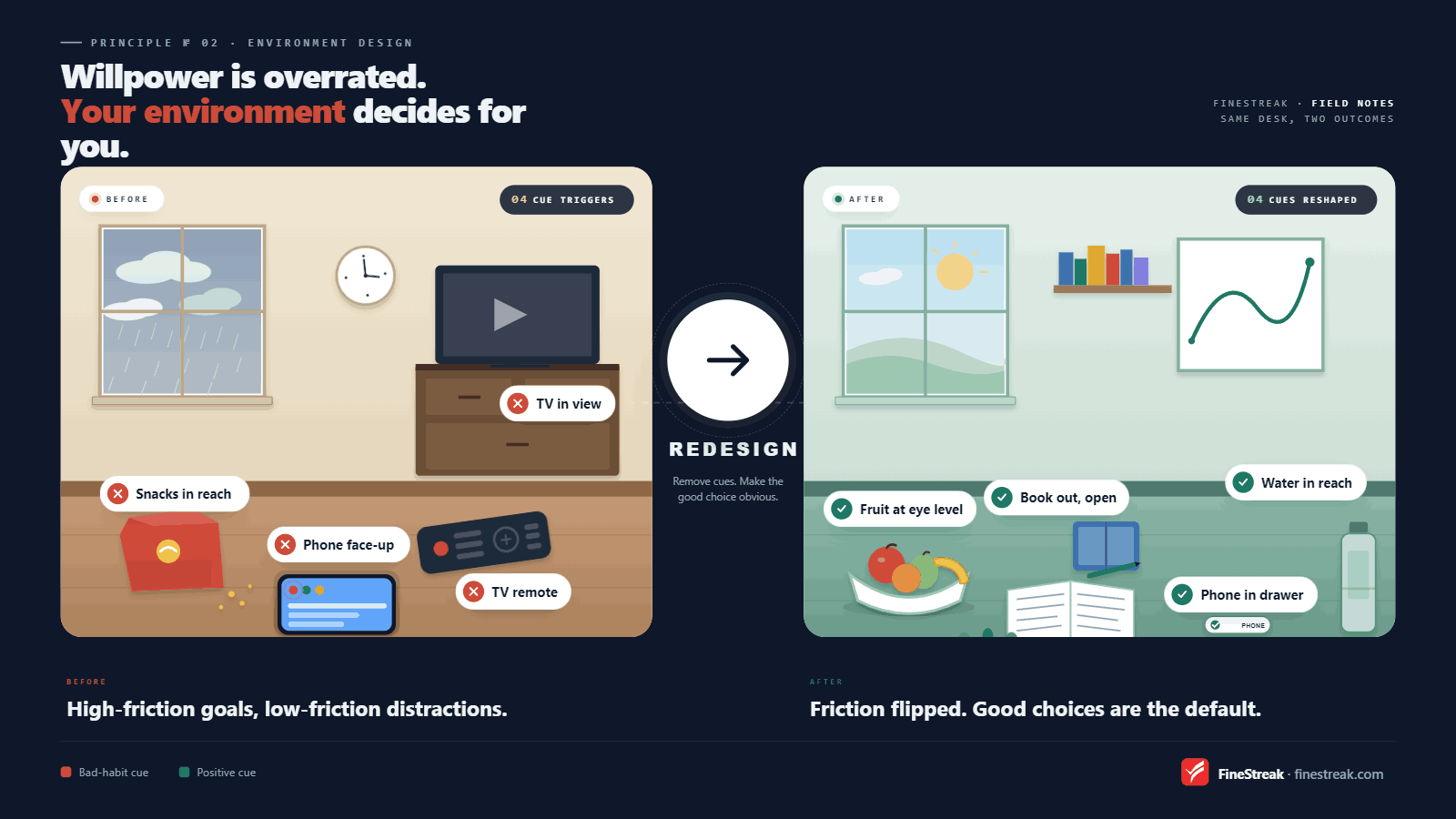
In 2005, Wendy Wood ran a study on students who had transferred universities. The ones who were heavy TV watchers at their old school often stopped watching at the new one. Not because they developed willpower over the summer. Because the TV was in a different room. The cue was gone.
That finding rearranged how behavioral scientists think about change. Environment beats willpower. Every time.
If you drink too much, do not keep wine in the house. If you snack at night, do not stock the pantry. If you doomscroll in bed, charge the phone in the kitchen. These sound obvious. That is the point. The obvious moves are the ones that work, because they remove the cue entirely instead of asking you to resist it a hundred times a day.
Make the bad habit harder by 20 seconds. Make the alternative easier by 20 seconds. That is usually enough. For a deeper playbook on this, read environment design for habits. When the bad habit is your phone specifically, the 20-second rule runs out fast, and an app that charges you for screen time is the version of this with a real cost attached.
The 5 Most Common Bad Habits and the Exact Swap for Each
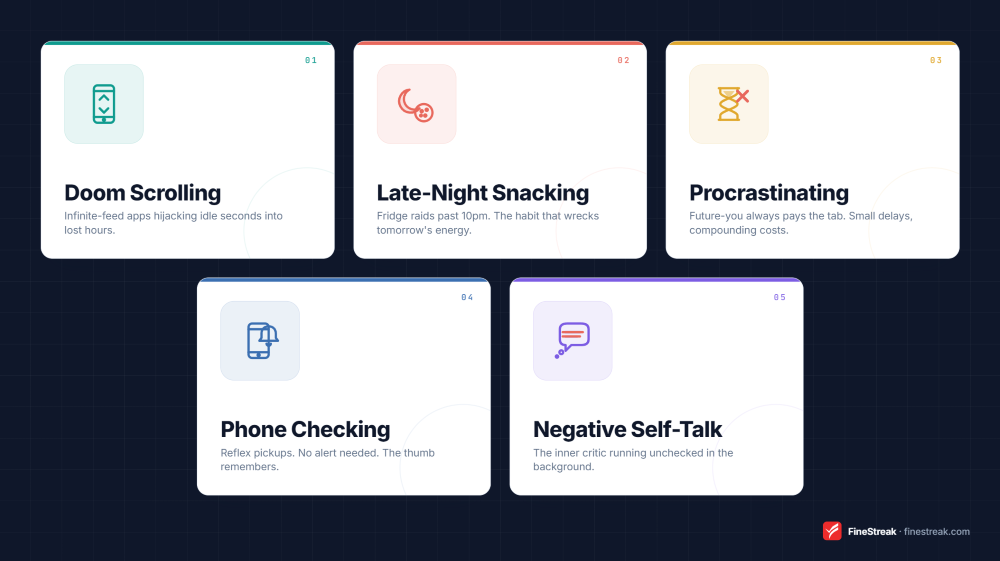
Frameworks only go so far. Here is how the five-step approach applies to the most searched bad habits, with the specific cue, reward, and routine swap for each.
1. Doom Scrolling
Cue: Boredom or any transition moment: sitting on the couch, lying in bed, waiting in line Reward: Stimulation and escape from quiet Swap: Put a book, podcast, or Kindle in the same physical spot. Same cue, same reward (escape), different routine. Charge the phone in another room so the automatic reach costs 20 extra seconds. If scrolling has crept into every spare minute, a broader digital minimalism reset tackles the whole pattern rather than one trigger at a time.
2. Late-Night Snacking
Cue: Evening TV combined with mild boredom or slight hunger Reward: Taste plus having something to do during downtime Swap: Pre-prepare a lower-calorie alternative (popcorn, sparkling water with fruit, herbal tea) in the same kitchen spot. The ritual of having something while watching TV is the actual reward, not the calories. Satisfy the ritual with a better swap.
3. Procrastinating on Important Work
Cue: Sitting at the desk with vague dread of the task ahead Reward: Temporary mood repair by escaping the anxious feeling Swap: Use the two-minute rule. Open the document and write one sentence only. The cue stays (desk plus dread), but the routine shrinks until the dread stops winning the negotiation. Once you start, momentum usually takes over.
4. Compulsive Phone Checking
Cue: Any idle moment at all: red lights, elevators, waiting for anything Reward: Novelty and the possibility of something interesting Swap: Put the phone in a bag on silent and replace the idle-moment reach with a 20-second breathing pause or a stretch. You will not eliminate the cue, but you introduce enough friction to break the automatic reach. Over time, the pause becomes the habit.
5. Negative Self-Talk After Mistakes
Cue: Making an error or missing a target Reward: A perverse sense of control ("at least I am holding myself accountable") Swap: Write one factual sentence about what happened, followed by one sentence about what you will do differently. Same sense of accountability, without the spiral. Research by Kristin Neff at UT Austin shows self-compassion after failure actually increases the likelihood of trying again, the opposite of what most people assume.
Step 5: Add External Accountability
You can do steps 1 through 4 alone. Most people still fail. Not because the framework is wrong, but because bad days exist, and on bad days your best plans get overruled by whoever is running your brain at 10pm.
This is where outside pressure earns its keep. When someone else is watching, and when quitting costs something real, you show up on the days willpower has already clocked out.
The research on this is blunt. Studies on commitment devices and financial penalties consistently show that putting money on the line roughly doubles success rates on quit attempts. A friend who checks in helps. A friend who checks in plus a real fine helps more, which is exactly why people reach for an app that charges you when you skip a day.
You do not need a lot of money on the line. You need enough to sting. The behavioral economics of it are covered in loss aversion explained, but the short version is this: losing $5 hurts more than gaining $5 feels good. Use that asymmetry.
Understanding why motivation runs out before discipline kicks in is critical here. Read discipline vs motivation for the full breakdown of why the gap matters and how to bridge it.
How FineStreak Approaches This
FineStreak is an accountability app that uses real fines and check-ins on the schedule you set to help people build lasting habits. We built it because we got tired of habit apps that let you ghost yourself.
You tell FineStreak the bad habit you are breaking. Every morning an AI gives you a phone call, asks how yesterday went, and logs it. If you miss a day, you pay the real fine you set, money that is simply gone. Your streak builds into ranks and a points leaderboard.
That is cue, routine, reward, environment, and accountability stacked in one loop. The AI call is the cue that lives outside your head. The fine is the environment you cannot wish away. The streak and ranks are the mirror. You still have to do the work. We just make the bad days survivable.
If you want to compare it against other options first, here is our honest take on the best accountability apps and how AI phone calls boost accountability.
A note on fines: they are optional. A member who wants one sets it up on the FineStreak website, and the FineStreak iPhone app leaves fines out entirely.
Frequently Asked Questions
How long does it really take to break a bad habit?▾
Research from Lally and colleagues at University College London found it takes anywhere from 18 to 254 days, with an average of 66. The 21-day number you have heard is a myth that came from a 1960 self-help book by a plastic surgeon, not a controlled study.
Why is willpower alone not enough to stop bad habits?▾
Duke University research shows about 40 percent of your daily actions are automatic, not conscious choices. Willpower works against an autopilot that fires thousands of times a day, so it usually loses. Changing your environment and your cues is far more effective than relying on willpower.
What is the cue-routine-reward loop?▾
A three-part model popularized by Charles Duhigg, based on Nathan Azrin clinical habit reversal work. A cue triggers a routine, which delivers a reward. To break the habit, you keep the cue and the reward but swap the routine for something healthier.
Does changing your environment actually help break bad habits?▾
Yes, and it may be the single most powerful lever available. Wendy Wood research found students who transferred universities naturally dropped TV-watching habits when the TV was in a new location. The context cue vanished, so the habit went with it.
How do financial consequences help break bad habits?▾
Loss aversion means losing money hurts roughly twice as much as gaining the same amount feels good. Commitment contracts that charge real money for slipping consistently outperform willpower-only approaches in clinical studies, with some research showing 70-80 percent success rates versus 10-15 percent for cold turkey.
How does FineStreak help break bad habits?▾
FineStreak is an accountability app that uses real fines and check-ins on the schedule you set to help people build lasting habits. It combines an AI phone call at the time you set, a real financial fine when you slip, and a streak system that builds into ranks and a points leaderboard, stacking external accountability on top of the cue-routine-reward work you do on your own.

Ready to stop making excuses?
FineStreak calls you at the check-in time you pick, tracks your goals, and charges a fine you set if you choose to add one. Free for 7 days, no card.
Try FineStreak free for a weekRelated Articles
Building Better Habits: The Complete Science-Backed Guide
The complete science-backed guide to building better habits. Learn how habits form, why they actually last, and how to engineer your life for automatic wins.

Identity-Based Habits: Skip the Goal, Become It
Identity habits beat outcome goals because they rewrite who you are. See the Clear and Wood research and the 3-step identity shift you can run this week.
Why Do I Keep Quitting the Gym? Where Each Attempt Breaks
Most gym attempts break at the same few points, and the first missed session is the most fixable. Here is the real dropout data and a restart plan that holds.
Why Do I Keep Quitting Things? The Mechanism Behind It (2026)
You quit because one missed day sets off an all-or-nothing cascade. Here is the named mechanism, the five reasons people abandon goals, and what to change.