Accountability App vs Habit Tracker: The Real Difference
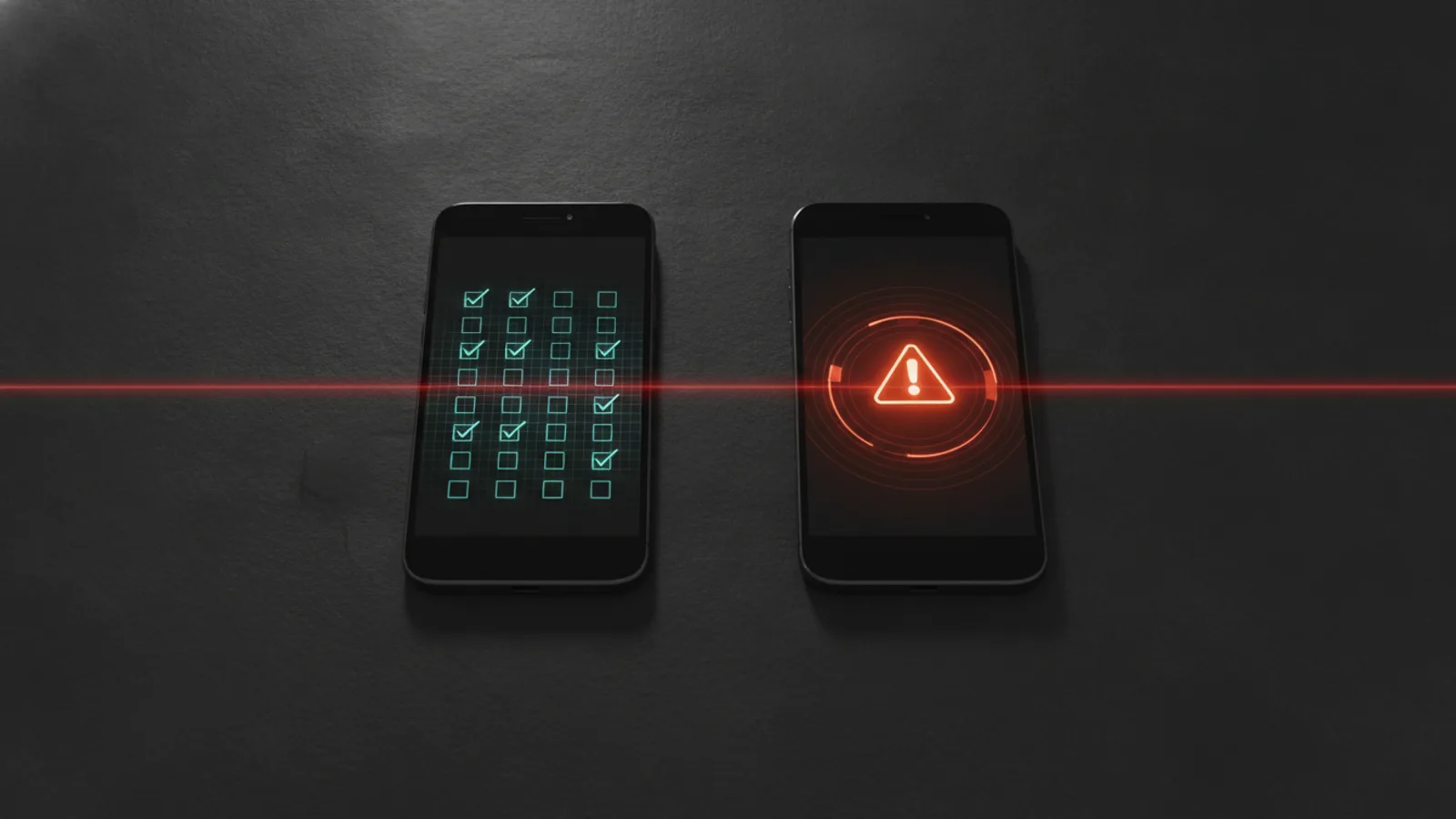
TL;DR: A habit tracker records what you did. An accountability app makes something happen when you do not. Trackers work well for habits you want and lose track of, and fail for habits you avoid, because a checkbox costs nothing to skip. If you have abandoned two trackers, try FineStreak free for 7 days, no card required.
The Short Answer
A habit tracker is a record. Checkboxes, streaks, charts, reminders. Its job is to show you what happened, and it does that well.
An accountability app is an enforcer. Its job is to make skipping cost something you agreed to in advance.
The test that separates them: remove the consequence. If what remains is still a useful product, it was a tracker. If what remains is not worth opening, it was an accountability app.
Which you need: trackers suit habits you want and lose track of. Accountability apps suit habits you avoid. Your own history answers this faster than any review.
The Distinction in One Table
| Habit tracker | Accountability app | |
|---|---|---|
| Core job | Record what happened | Act when it does not happen |
| When you skip | A counter resets | A consequence you chose lands |
| Who supplies the pressure | You | The system, or a person |
| Verification | You tick a box | Evidence is examined |
| Typical cost | Free to a few dollars | $5 to $200 per month |
| Fails when | You stop opening it | The consequence is set too low |
| Best for | Habits you want and forget | Habits you avoid |
Why Tracking Works, and Where It Stops
Tracking earns its place. Watching your own behaviour genuinely changes it, and that effect is the foundation the entire category is built on. A tracker delivers it with almost no friction, which is why the free ones are perfectly good.
Where it stops is specific and predictable. A checkbox costs nothing to tick and nothing to skip.
That has two consequences people run into.
A tracker measures your honesty as much as your behaviour. On the days you are honest, the data is real. On the day you tap "done" because the streak is at 34 and you cannot face breaking it, the record is fiction and the app has no way to know. If that has happened to you, the system tracked accurately, and what it tracked was a lie.
Nothing arrives on the day you skip. The notification comes at six, you swipe it, and the transaction is complete at no cost. Nothing about that required a decision, so nothing about it registered as one. Two weeks of that and the banner is furniture. We went through what each app type actually does at that moment in what happens when you ignore your habit app.
Why Accountability Apps Work Differently
They change the arithmetic of a single moment: the one where you decide whether to go.
In a tracker, that decision costs you a number. In an accountability app, it costs you something you agreed in advance you would rather keep.
Loss aversion explains the size of the gap: a loss is felt roughly twice as strongly as an equivalent gain. The catch with a streak is that it is a gain you are protecting, and protected gains are easy to hand back quietly when nobody is counting.
Money behaves differently because the ledger is external. You can still skip, and people do, but the record of that decision sits somewhere you did not author.
The other half is contact. A tracker waits for you to open it, which means it is absent from the decision entirely. An app that calls or texts at your check-in time is present at the moment the decision is being made, and presence at the decision point is worth more than any feature on the record side.
Being honest about the limit: a consequence changes the cost of one choice at one moment. It does not create motivation. For a habit you actively do not want, that will not be enough and nothing on this page will be. For a habit you want and keep postponing, it is usually the whole problem.
Which One Do You Need?
The question is which failure you have, rather than which product is better.
| What actually happens | You need |
|---|---|
| I want to do it and lose track | A tracker. Free is fine |
| I like seeing the data and it motivates me | A tracker. Keep the one you have |
| I tick the box without doing the thing | Verification |
| I see the reminder and do nothing | Contact, rather than a louder reminder |
| I have abandoned two trackers for this habit | A consequence |
| I only miss when I travel or get busy | A tracker plus a plan for disruption |
| Nothing bad happens when I skip, so I skip | An accountability app |
One abandonment is ordinary. It might have been the app, the timing, or a goal you did not really want.
Two is a pattern, and the pattern is that recording your behaviour is not changing it. Trying a third tracker at that point is choosing the variable that has already failed twice. Why habits fail long-term covers the wider shape of this, and commitment devices that work covers what tends to replace the tracker.
If the tracker you are leaving is Streaks specifically, we compared the alternatives by the reason people switch, including the ones that check your evidence.
The Overlap Nobody Mentions
Most accountability apps contain a habit tracker, because they need the record to know whether you missed. That makes the categories look blurrier than they are.
The clean way to tell them apart is to ask what would survive if the consequence were removed. Take the fines out of a penalty app and you have an ordinary tracker that nobody would pay for. Take the streaks out of a tracker and you have nothing. The weight sits in different places, and where the weight sits is what determines whether you are still using it in November.
This also explains an upgrade that is rarely worth buying. Paying for the premium tier of a habit tracker generally buys reminders, widgets, statistics and themes. Not one of those is a consequence, so the paid version has the same ceiling as the free version with a nicer interface. If a free tracker did not hold you, its subscription will not either.
The Summary
The category is split down the middle and the marketing hides the seam. Both sides say "build better habits", and only one side does anything on the day you do not.
Start with a tracker, because it is free and because it might be enough. Watch what happens in week four. If the streak is alive, you are done and you never needed anything else. If the streak is alive but the habit is not, you need verification. If both are gone, you need a consequence, and no amount of better tracking is going to supply it.
Start a free week if you already know which of those you are.
A note on fines: they are optional. A member who wants one sets it up on the FineStreak website, and the FineStreak iPhone app leaves fines out entirely.
Frequently Asked Questions
What is the difference between an accountability app and a habit tracker?▾
A habit tracker records what you did. An accountability app makes something happen when you do not. That single distinction predicts whether you are still using the product in week six better than any feature comparison. Trackers give you checkboxes, streaks, statistics and reminders, all of which are pleasant and none of which cost anything to ignore. Accountability apps attach a consequence you agreed to in advance: money charged, a call placed, a group affected. In a tracker the record is the product. In an accountability app the consequence is the product.
Is a habit tracker enough to build a habit?▾
For some habits and some people, genuinely yes. Watching your own behaviour changes it, which is a well-supported effect and exactly what a tracker delivers. Tracking tends to be enough when the habit is something you want to do and simply lose track of, such as taking a supplement or drinking water. It tends not to be enough when the habit is something you avoid, because a checkbox costs nothing to tick and nothing to skip. The clearest test is your own history: if you have abandoned two trackers, tracking is not your missing ingredient.
Do I need an accountability app or just better willpower?▾
Framing it as willpower is usually the reason the last three attempts failed. Willpower is the resource that has already run out by the time you are deciding whether to skip, so a plan that depends on more of it is a plan that depends on the thing you do not have. Accountability apps work by changing the arithmetic of that moment rather than by increasing your capacity to endure it. A small amount of your own money at risk makes skipping cost something, which is a structural change rather than a motivational one.
Can one app be both a habit tracker and an accountability app?▾
Yes, and most accountability apps include tracking because they need the record to know whether you missed. The distinction turns on where the product's weight sits rather than on which features exist. If removing the consequence would leave a usable product, it is a tracker with extras. If removing the consequence would leave nothing worth opening, it is an accountability app. Checking which half you would miss is a quick way to tell which kind you are actually looking at.
When should I switch from a habit tracker to an accountability app?▾
When you have abandoned two trackers for the same habit. One abandonment is ordinary and could be the app, the timing or the goal. Two is a pattern, and the pattern is that recording your behaviour is not changing it. At that point trying a third tracker is choosing the variable that has already failed twice. The useful move is to change what happens when you skip rather than to change what displays when you succeed.

You already tried the one that lets you off.
FineStreak is the version where a miss gets noticed the same day. An Agent calls or texts at the time you chose, asks for proof, and charges the fine you picked if you set one. Free for 7 days, no card.
Try the one that checksRelated Articles

10 Best Accountability Apps in 2026 (Tested and Ranked)
The 10 best accountability apps of 2026, ranked by real-consequence design. Which apps use fines, AI check-ins, and social pressure best.
What Happens When You Ignore Your Habit App? Usually Nothing
Every habit app is judged on features. The only test that predicts week six is what it does the day you ignore it. Here is what each one actually does.

7 Habit Tracking Methods Compared: Which One Sticks? (2026)
Apps, journals, calendars, spreadsheets, and AI check-ins compared. See which of the 7 habit tracking methods fits your goal, budget, and follow-through.

Why Habits Fail in Year Two (Not Year One)
Habit guides obsess over the first 66 days. The harder problem is year two: context disruption, identity drift, and creeping compromise unravel a habit.