Building Better Habits: The Complete Science-Backed Guide
TL;DR: Roughly 43% of what you do every day runs on autopilot. That makes your habits the infrastructure of your life. This guide unpacks the actual science of how habits form and what it takes to build ones that last.
You already know the self-help version of habits. Start small. Be consistent. Don't break the chain. That advice isn't wrong, but it's the surface layer. Underneath is a body of research from Duke, UCL, USC, and Stanford that explains the actual mechanism, and once you understand the mechanism you stop relying on motivation and start engineering outcomes.
This is the long version. Pour a coffee.
Why Habits Are the Infrastructure of Your Life
Wendy Wood, a behavioral scientist at USC who has spent thirty years studying habits, ran a now-famous study at Duke University in 2002 with Jeffrey Quinn and Deborah Kashy. They tracked students across a week of self-reported behavior. The finding: about 43% of daily behaviors were performed habitually, in the same location, at roughly the same time, without conscious deliberation.
A follow-up study in 2006 pushed that number to around 40% of daily activities being cued by the same physical context each day. Brushing your teeth. The route you drive to work. What you eat for breakfast. The tab you open first when you sit down at your computer.
43% of your daily behaviors are on autopilot. You're not consciously choosing most of what you do. You're running programs installed years ago.
Think about what that means for goal setting. If nearly half your day is pre-determined by habits, the question isn't "what do I want to achieve this year." The question is "which autopilot programs are running, and are any of them pointing where I actually want to go?"
Your habits are the silent compound interest of your life. A 10-minute walk after dinner isn't impressive on any given Tuesday. Do it 300 times in a year and your cardiovascular system, sleep quality, and relationship with your partner all quietly improve. Skip it 300 times and you've coasted in the other direction without noticing.
Most people never audit this. They set New Year's resolutions that try to muscle through their existing autopilot instead of replacing it. That's why resolutions fail by February.
The Science of How Habits Form
A habit is a learned association between a cue and a behavior, stored in a part of the brain called the basal ganglia. Once the association is strong enough, the cue alone is enough to trigger the behavior without conscious thought.
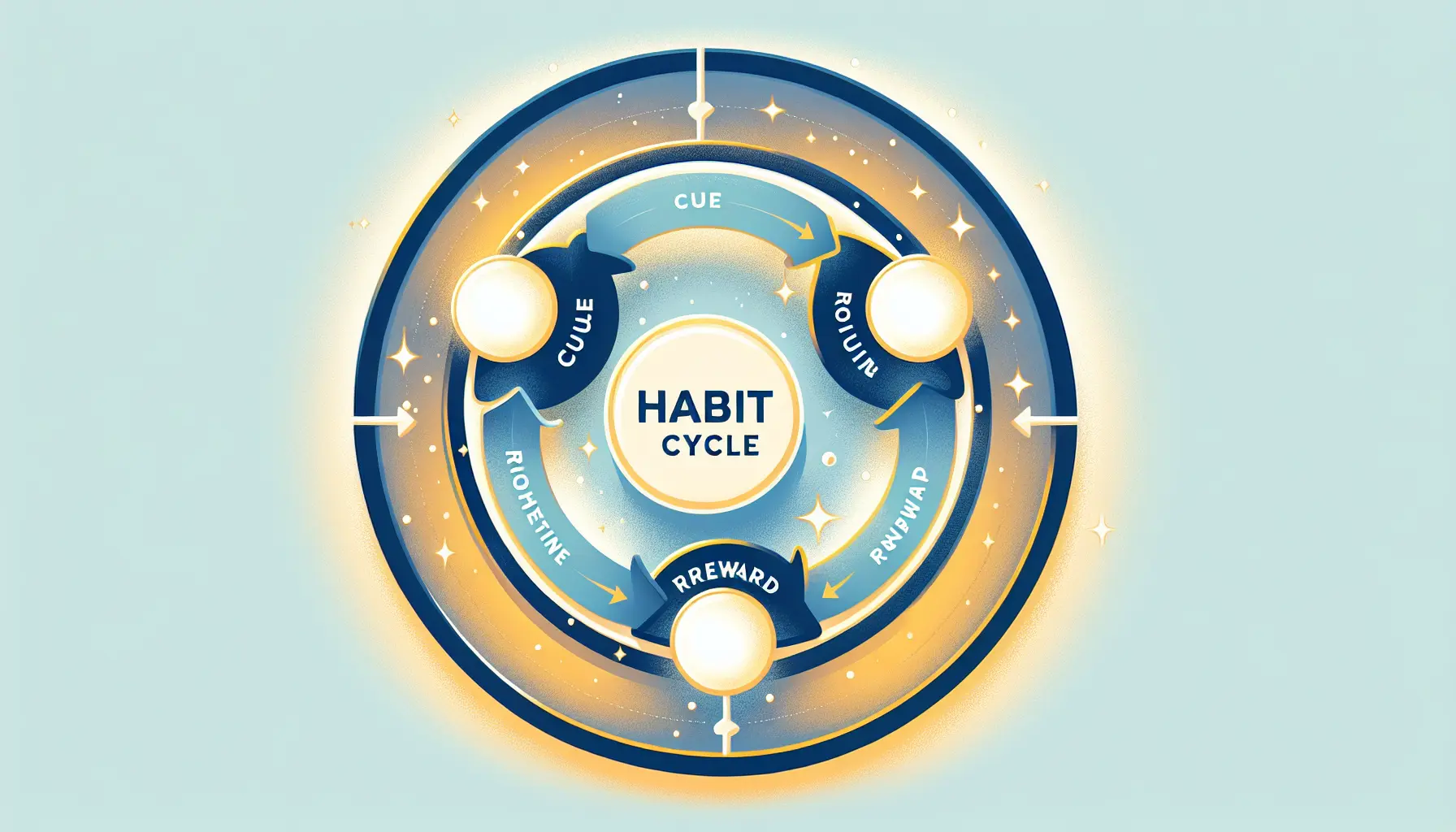
Charles Duhigg popularized this as the "habit loop" in his book The Power of Habit: cue, routine, reward. Newer frameworks, especially James Clear's in Atomic Habits, expand it to four stages: cue, craving, response, reward. Both are pointing at the same neuroscience, and both land near the top of our ranking of discipline and habit books.
Here's what's actually happening under the hood:
- Cue. Your brain notices a trigger in the environment. Time of day, a location, an emotional state, a preceding action, another person.
- Craving. The cue predicts a reward, and dopamine spikes in anticipation. This is the motivational fuel.
- Response. You perform the behavior. The easier it is, the more likely it happens.
- Reward. The brain receives the payoff, tags the whole loop as worth remembering, and strengthens the neural pathway.
Repeat this enough times and the pathway becomes so efficient the prefrontal cortex disengages. You stop "deciding" to do the thing. The cue fires and the behavior happens. This is what researchers call automaticity, and it's the actual finish line of habit formation.
The critical insight is that habits aren't built through willpower. They're built through repetition in a stable context. Every time you perform the behavior in the same setting with the same cue, the association gets a little stronger. Skip a day here and there and progress slows but doesn't reset. Change the context entirely and the habit frequently collapses, which is why people's routines fall apart when they travel or move.
How Long Does It Really Take?
You've probably heard the "21 days to form a habit" line. That number comes from a 1960 book by plastic surgeon Maxwell Maltz, who observed that his patients took about 21 days to adjust to a new nose. Not a habit study. Not peer-reviewed. Just a surgeon's casual observation that went viral in the self-help world.
The actual research comes from Phillippa Lally and her team at University College London, published in 2010 in the European Journal of Social Psychology. They followed 96 volunteers who each picked a new daily health behavior and self-reported how automatic it felt.
The average time to reach automaticity was 66 days. The range was 18 to 254 days. Our complete guide to habit formation breaks down what that timeline asks of you stage by stage.
| Habit Type | Avg. Days to Automaticity |
|---|---|
| Simple (drinking a glass of water after breakfast) | 18-30 days |
| Moderate (a 10-minute walk after dinner) | 40-80 days |
| Complex (a full exercise routine) | 60-254 days |
Lally's team found that complex behaviors like exercise took about 1.5 times longer than simple ones. They also found that missing a single day had virtually no impact on long-term progress. Missing several days in a row did.
If you want a deeper breakdown of where the 21-day myth came from and why it refuses to die, read the 66-day habit myth.
The practical takeaway: budget two to three months for a meaningful habit to feel automatic, and six to eight months for a complex one. If you're three weeks in and it still feels like work, you're not failing. You're exactly where the research says you should be. Those windows can stretch a little later in life, which is why building habits after 40 leans even harder on patience and small starts.
The 4 Laws of Behavior Change
James Clear synthesized decades of behavioral research into a framework he calls the Four Laws of Behavior Change. It maps cleanly onto the cue-craving-response-reward loop and gives you a practical lever at every stage.
Clear's 4 Laws:
- Make it obvious. Design your environment so the cue is unavoidable. If you want to read more, the book sits on your pillow. If you want to drink more water, the bottle sits on your desk. Invisibility kills habits. Visibility starts them.
- Make it attractive. Bundle the new habit with something you already enjoy. Only watch your favorite show while on the treadmill. Only listen to that podcast while prepping meals. Dopamine gets pre-loaded by the thing you like, and the new behavior rides along.
- Make it easy. Reduce the friction to the minimum viable action. Clear calls this the two-minute rule. When you are building an exercise habit, don't commit to a 45-minute workout on day one. Commit to putting on your running shoes. The goal in the first month is not performance, it is showing up.
- Make it satisfying. Close the loop with an immediate reward. The brain won't strengthen a pathway that doesn't pay off right away. Long-term rewards like "being healthier in five years" don't register. A checkmark on a habit tracker, a small treat, a text to a friend, all of these work.
To break a bad habit, you invert each law. Make the cue invisible. Make the craving unattractive. Make the response difficult. Make the reward unsatisfying. Want to stop doom-scrolling at night? Charge your phone in the kitchen (invisible), delete the app from your home screen (difficult), and put a $3 fine on every evening you cave (unsatisfying).
This framework isn't the only model, but it is the most actionable one you'll find. Every other habit approach, from implementation intentions to tiny habits to behavior design, is a variation on these four levers.
Common Mistakes That Kill New Habits
Most new habits die for predictable reasons. If you know the failure modes in advance, you can design around them.
Going too big too fast. You decide to meditate for 20 minutes a day, go to the gym five times a week, and cut out sugar. Week one is glorious. Week three is a smoking crater. The research is clear: start absurdly small and scale up only after the cue-response loop is automatic. Two minutes of meditation daily beats 20 minutes three times before you quit.
Relying on motivation. Motivation is a mood, not a system. It shows up when life is easy and vanishes when you need it most. Any habit plan that requires you to "feel like it" is a plan that will fail in the first stressful week. Environment and commitment devices do the work that motivation can't. Read more about commitment devices that work.
No implementation intention. Peter Gollwitzer and Paschal Sheeran's 2006 meta-analysis of 94 studies found that simply writing down "when X happens, I will do Y" produced a medium-to-large effect (d = .65) on goal attainment. "I will exercise more" is useless. "When I finish my morning coffee on weekdays, I will do 20 pushups in my kitchen" is an implementation intention. The specificity matters.
Framing goals as avoidance. A 2020 study of New Year's resolutions tracked 1,066 participants over a year. Approach-oriented goals ("I will run three times a week") had a 58.9% success rate at 12 months. Avoidance-oriented goals ("I will stop eating junk food") had a 47.1% success rate. The framing alone was worth an 11.8 percentage point gap. Your brain is bad at not-doing. Replace the negative behavior with a positive one.
No real consequence for missing. This is where most people's habit plans fall apart. There's no immediate cost to skipping. Tomorrow feels the same as today. Your brain isn't wired to care about vague future outcomes, it's wired to care about immediate feedback. A financial penalty, a public commitment, or a person who checks on you all create the short-term consequence your nervous system actually responds to.
Tracking badly or not at all. If you can't see the streak, the habit feels like effort without evidence. A simple calendar with an X through each completed day, what Jerry Seinfeld famously called "don't break the chain," gives your brain the immediate reward it needs to strengthen the loop.
Environment Design: Set Yourself Up to Win
Wendy Wood's research keeps returning to one uncomfortable truth: willpower is overrated and environment is underrated. People who appear to have iron discipline almost always have environments that make the good choice the easy choice.
A 2015 study Wood co-authored found that students who moved to a new campus were dramatically more likely to change their exercise, eating, and TV habits than students who stayed put. The habit was stored in the context, not the person. Change the context and the old cues stop firing.
You can exploit this deliberately. Here's how.
Put the cue in your face. If you want to practice guitar, the guitar lives on a stand in the living room, not in a case under the bed. If you want to take vitamins, the bottle sits next to your toothbrush. Visual cues are so powerful they often outweigh conscious intention.
Remove the friction. Lay out workout clothes the night before. Pre-cut vegetables on Sunday. Pre-fill the coffee maker. Every step you eliminate between cue and response is one less place for the habit to die. Conversely, adding friction to bad habits works just as well: unplug the TV, log out of the app, put the snacks on the top shelf.
Segment your spaces by behavior. Don't answer email in bed. Don't eat at your desk. Don't scroll on the couch. When a space means one thing, the cues stay clean and the habits stay strong. When every space means everything, every cue gets diluted.
Use other people's environments to your advantage. You pick up the habits of the five people you spend the most time with, not because they lecture you, but because their environments become your environments. Want to read more? Join a book club. Want to run more? Run with someone who runs.
For a deeper treatment of this, see the guide on environment design for habits.

There's one more environmental lever most people ignore: temporal cues. Habits built at the same time each day, anchored to a stable routine, outperform habits you try to fit in "whenever." Your brain uses time of day as a cue the same way it uses location. A 7:00 a.m. habit is structurally different from a "sometime in the morning" habit.
How Identity Quietly Decides Everything
There's a subtle shift in how you think about a new habit that determines whether it sticks or not. Most people frame habits around outcomes. I want to lose 20 pounds. I want to write a book. I want to learn Spanish. Outcome goals are fine for pointing a direction, but they're terrible for sustaining behavior because every day you haven't reached the outcome is a day you feel like a failure.
The alternative is identity-based habits. Instead of "I want to run a marathon," you say "I am a runner." Instead of "I want to write a book," you say "I am a writer." The habit isn't something you do. It's evidence of who you are.
This sounds like semantic fluff until you look at the research. People who adopt identity framing are significantly more resistant to lapses because a single missed day doesn't threaten the identity. A runner who skips a Tuesday is still a runner. A "person trying to lose 20 pounds" who eats a cookie has broken the plan.
Every time you perform the habit, you're casting a vote for the person you're becoming. One vote doesn't matter. A thousand votes is a new identity. And once the identity consolidates, the habit stops feeling like effort and starts feeling like self-expression.
The practical move: every time you do the small version of your habit, say out loud or silently, "this is what someone like me does." It feels stupid. It works.
How FineStreak Approaches This
Most of the research in this guide is decades old. The reason habits are still hard to build in 2026 isn't that the science is missing. It's that the frameworks live in books and the books live on nightstands and nothing between your intention and your action has any teeth.
FineStreak closes that gap with three things that match what the research actually says works.
AI phone calls that become your cue. At the check-in time you set, a short AI call runs through your commitments. It is a conversation you have to actually take part in. There is no swipe that makes it go away. The call itself becomes a stable environmental cue, the kind Wendy Wood's research says anchors behavior in place.
Real financial fines that make loss aversion do the work. When you miss a commitment, you lose the fine you set, anywhere from one to fifty real dollars. Small enough that it doesn't wreck you. Big enough that your nervous system cares. Loss aversion research consistently shows people work about twice as hard to avoid losing money as to gain the same amount, which is exactly the immediate consequence habit formation requires. More on this in loss aversion explained.
Ranks and game-style progress. Streaks build into ranks, and a points leaderboard stacks a little healthy competition onto the financial fines, closing the habit loop with the "make it satisfying" reward.
No other app combines AI phone calls, real financial consequences, ranks, and game-style progress into one system. If you are comparing it against a familiar habit tracker, FineStreak versus HabitBull lays out what changes when missing a day actually costs something. You can stitch these together yourself with a notebook, a friend, and Venmo, and some people do. Most people won't, which is why the app exists. Take a look at FineStreak if you want the research to actually touch your calendar tomorrow morning.
If you're still weighing whether an app or a human partner is the better fit for you, read our app versus human partner comparison.
Putting It All Together: Your 90-Day Habit Plan
Reading about habits doesn't build them. Here's a concrete 90-day plan that combines everything in this guide. If you prefer a shorter, checklist-style version, our practical habit-building guide condenses the same playbook.
Days 1 to 7: Pick one keystone habit. Not three, not two. One. Choose a keystone habit, a behavior that, if it became automatic, would have downstream effects. Morning exercise, daily writing, a single glass of water before coffee. Write an implementation intention: "When X happens, I will do Y, at Z location."
Days 8 to 21: Make the action absurdly small. Two minutes or less. Resist the urge to scale up early, even if it feels too easy. You are not training the behavior yet, you are training the cue-response link. Show up every day. Mark it on a calendar.
Days 22 to 45: Add environment reinforcement. Put the cue in your face. Remove friction. Attach an immediate reward. If you're still relying on willpower at this stage, something is wrong with your setup. Redesign the environment, not your motivation.
Days 46 to 66: Add a real consequence for missing. A fine, a public commitment, a person who checks on you, a FineStreak call. This is where most habits die without teeth. If a day only holds together when real money is on the line, then put real money on the line.
Days 67 to 90: Scale the action and lock the identity. Now you scale up. Two minutes becomes ten. Ten becomes twenty. You start saying "I'm a runner" out loud. You stack a second habit on top of the first one. You do not add a third until the second is on autopilot. For more on stacking, see the habit stacking guide.
By day 90 the habit should feel less like a project and more like a fact about you. If it still feels like effort, extend the plan. Lally's research says some habits take 254 days. You are allowed to be one of those people.
A note on fines: they are optional. A member who wants one sets it up on the FineStreak website, and the FineStreak iPhone app leaves fines out entirely.
Frequently Asked Questions
How long does it really take to build a new habit?▾
Research from Phillippa Lally at UCL found the average is 66 days, but the range runs from 18 to 254 days depending on complexity. Simple habits like drinking a glass of water after breakfast stick fastest. Complex behaviors like a full exercise routine can take four months or more.
What is the most important factor in building a new habit?▾
Consistency of the cue matters more than intensity of the action. A two-minute version of your habit performed daily at the same trigger will outperform a perfect one-hour version you skip twice a week. The brain encodes habits through repetition in stable contexts.
Why do most new habits fail within the first month?▾
Most new habits fail because people rely on motivation instead of environment design and because they set the initial action too large. When the friction of doing the habit exceeds the friction of skipping it, willpower breaks down within a few weeks.
Is it better to focus on one habit at a time or build several at once?▾
Focus on one keystone habit until it runs on autopilot, usually 60 to 90 days. Trying to install three or four new behaviors at once splits your cognitive budget and tends to produce zero stuck habits instead of one. Stack new habits onto the keystone once it is automatic.
Do financial penalties actually help build habits?▾
Yes, and the research on loss aversion is unusually strong. Studies show people work roughly twice as hard to avoid losing money than to gain the same amount. A small fine attached to a missed commitment creates the immediate consequence that habit formation requires.

A checkbox costs nothing to tick.
FineStreak looks at your evidence. A vision model matched to your specific goal, EXIF capture time, and blocking so a photo from last Tuesday cannot be sent twice. Free for 7 days, no card.
See what real verification looks likeRelated Articles

Habit Stacking: How to Build New Habits by Piggy-Backing on Old Ones
Habit stacking attaches new behaviors to existing routines so your brain treats them as one unit. Here's the formula, the science, and real examples.

The 66-Day Habit Myth: How Long Does It Really Take to Form a Habit?
The 66-day habit rule and the 21-day habit myth are both wrong. Here is what behavioral research actually says about how long it takes to form a habit.

Environment Design for Habits: How to Make Good Behavior the Default
Your environment cues about 43% of daily behavior. Learn to redesign your home and workspace so good habits feel automatic and bad ones get real friction.

Keystone Habits Examples: 5 Small Changes That Rewire Everything | FineStreak
Keystone habits trigger chain reactions that rewire your whole routine. Here are 5 keystone habit examples backed by research, plus how to start one this week.