Habit Streaks Psychology: Why the Chain Hurts to Break (2026)

The Short Answer
Streaks work because of loss aversion. Kahneman and Tversky showed in 1979 that losing something hurts about twice as much as gaining the equivalent feels good, so once a chain of days belongs to you, breaking it registers as a theft. Three forces stack: loss aversion makes the streak painful to lose, the endowment effect makes it feel more valuable the longer it runs, and visible progress gives your brain a concrete reason to come back tomorrow. The evidence holds at scale. Duolingo users who reach a 7-day streak are 2.4x more likely to open the app the next day, and a 2025 University of Alberta study across six experiments found that escalating streak rewards beat flat per-task pay even when the streak schedule paid less overall. The catch is that the same psychology that builds the chain can turn one missed day into permission to quit entirely.
In the early 1990s, a young software developer named Brad Isaac cornered Jerry Seinfeld backstage at a comedy club and asked for advice. Seinfeld skipped past jokes entirely. He talked about a calendar.
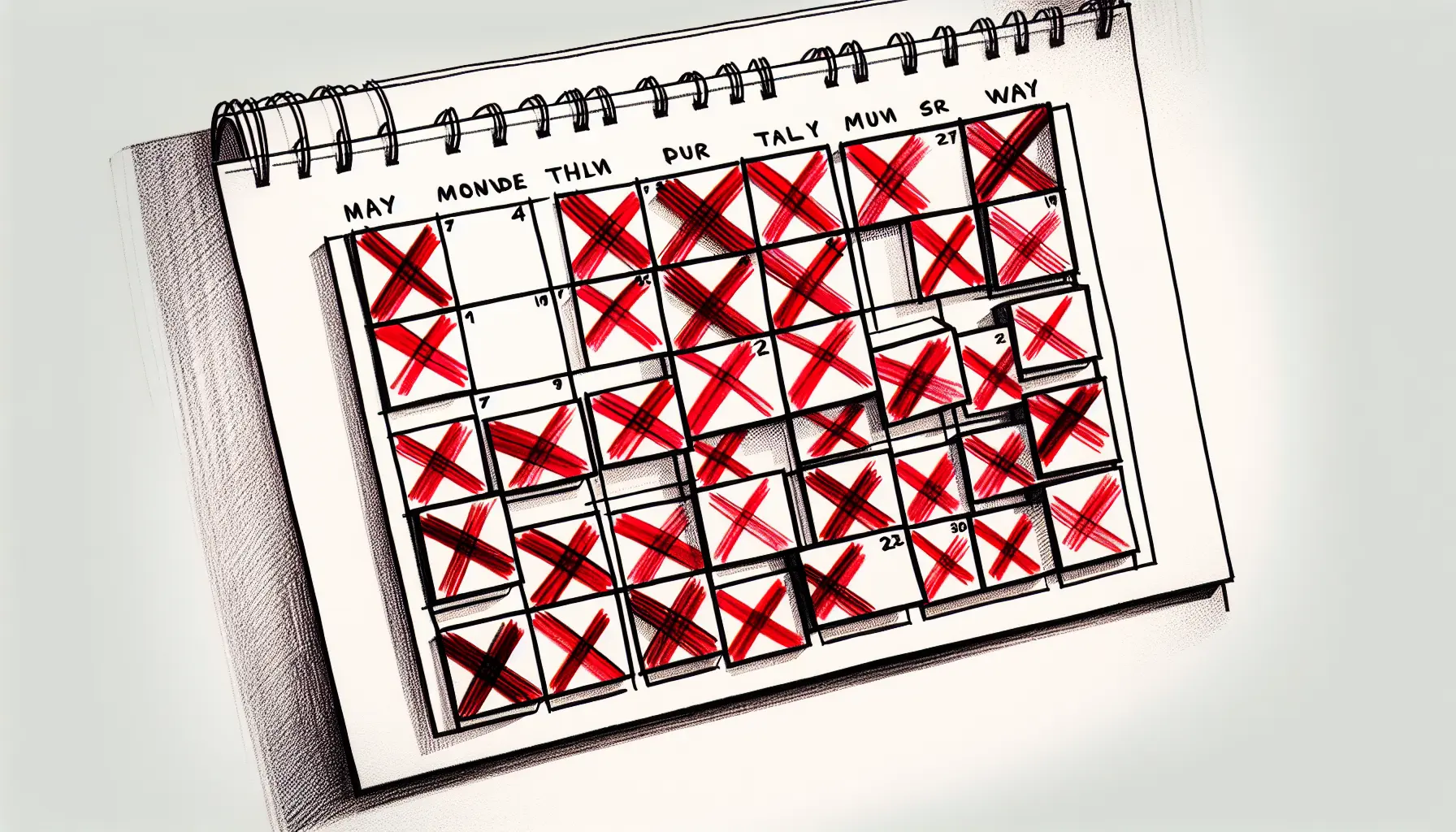
Hang a year-on-one-page wall calendar. Every day you write new material, draw a big red X over that date. After a few days, you have a chain. "Your only job," Seinfeld said, "is to not break the chain." This is the don't-break-the-chain method in its original form.
That single piece of advice, later published on Lifehacker, quietly became one of the most influential productivity ideas of the last thirty years. It also happens to be a nearly perfect exploitation of how the human brain calculates loss.
Where Did the Seinfeld Strategy Come From?
Seinfeld was describing something he had stumbled onto as a working comedian, with no behavioral economics in mind: writing every day matters more than any single great session. The calendar worked as a visible commitment you could watch yourself break.
The genius was making the absence of progress physically visible. A blank square next to a row of red Xs nags at you every time you walk past it, while a missed task buried in an app quietly disappears. You cannot scroll past a wall calendar. The calendar is one of seven options we put side by side in habit tracking methods, and physical visibility is the axis it wins on.
Isaac shared the story on Lifehacker in 2007, and it spread to every productivity blog, habit app, and founder Twitter account from there. Today almost every one of the best habit tracking apps has some version of it built in. Most of them do not understand why it works.
Why Do Streaks Work? Loss Aversion in Action
In 1979, Daniel Kahneman and Amos Tversky published "Prospect Theory: An Analysis of Decision under Risk" in Econometrica. Buried inside one of the most cited economics papers of all time is a finding that matters more for habits than almost any other piece of research: the pain of losing something is roughly twice as powerful as the pleasure of gaining something equivalent.
Losing $100 hurts about as much as finding $200 feels good. Losing a week you already worked for hurts about as much as earning two weeks you don't have yet.
This is why streaks hit so hard. By day 30, a streak has crossed over into something you own, and breaking it lands like being robbed.
The longer the streak, the stronger the effect. Psychologists call this the endowment effect, and it is a direct descendant of loss aversion. You value things more once they're yours. Your streak belongs to you by day 40 in a way it didn't by day 4. For a deeper breakdown of the underlying bias, read our explainer on loss aversion.
What Duolingo's Streak Numbers Show
| Measure | Reported effect |
|---|---|
| Next-day return rate, users with a 7-day streak | 2.4x higher than users without one |
| Day-14 retention, after adding the streak mechanic | +3.3% |
| Day-7 retention, Streak Wager (users wager currency on their streak) | +14% |
| Share of daily learners on a streak, after streak features shipped | +10.5% |
What Does the Latest Research Say About Streak Incentives?
People work harder for a streak than for the same money paid flat. That is the headline finding of "The motivating power of streaks: Increasing persistence is as easy as 1, 2, 3", published in March 2025 in Organizational Behavior and Human Decision Processes by Katie Mehr and her co-authors at the University of Alberta. Across six experiments with 4,504 participants, it is among the first work to systematically test whether streak incentives work on their own terms.
The design was simple. Pay people a flat rate per task completed, or pay them on a streak schedule where each consecutive completion earns slightly more than the last. The streak group completed more work. The result that matters: they did it even though the streak schedule left them with marginally less total pay.
Participants worked harder for the streak schedule while earning less from it. A streak reframes a pile of separate tasks into one continuous thing you are either keeping alive or killing, and that framing pulled harder than the payout did. The researchers describe streak incentives as a simple, low-cost way to boost persistence, which the University of Alberta's summary of the work frames as a practical tool for employers.
This matters because most streak evidence comes from app telemetry, which is useful but confounded: the people who build streaks may simply be the people who were going to show up anyway. A controlled experiment removes that objection. The chain is doing real work, independent of whatever reward sits at the end of it, which is also why losing the chain stings more than people expect.
What Does the Science Behind "Don't Break the Chain" Actually Show?
Duolingo users who reach a 7-day streak are 2.4x more likely to open the app the next day than users without one. That figure comes from Duolingo's own published write-up of its streak data, and the company has more of this data than anyone: it reported more than 37 million daily active users in 2024, and the longest recorded streak on the platform runs past 4,200 days. That is more than eleven years without missing a single day of language practice.
The rest of Duolingo's numbers make the streak mechanic look like behavioral physics. Adding streak mechanics produced a 3.3% lift in Day-14 retention and increased the share of daily learners on a streak by 10.5%.
Then there's the Streak Wager. Duolingo ran an A/B test where users could wager in-game currency on maintaining their streak. If they held the chain, they got the currency back plus more. If they broke it, they lost what they put up. The result: a +14% lift in Day-7 retention.
Read that again. Simply giving users the option to lose something on purpose made them 14% more likely to keep showing up. That is loss aversion, measured in the wild, at a scale most researchers would kill for. For more on why financial penalties work in habit systems, see do financial penalties change behavior.
4,504 participants, six experiments. People completed more work on a streak schedule than on flat pay, while earning less for it. The chain itself is the incentive.
Choosing a streak app is a separate question from understanding the mechanic, and the Streaks alternatives comparison sorts the field by the reason people leave one.
When Do Streaks Go Wrong?
Streaks are powerful, which means they can also be dangerous. The same psychology that makes them work creates two specific failure modes.
The first is obsession. When the streak becomes more important than the underlying habit, people start gaming it. They do a 30-second Duolingo lesson at 11:58 PM just to keep the number alive. The habit hollows out while the streak grows.
The second is worse: the all-or-nothing collapse. The pattern is familiar to anyone who has run a long streak. You are on day 47, a work deadline eats your morning, and the run doesn't happen. The missed run barely matters on its own. By nightfall the streak is gone, and the thing that was motivating you goes with it.
Psychologists have a name for this. The abstinence violation effect describes what happens when you hold an all-or-nothing standard, break it, and then read the failure as total, which makes quitting feel like the consistent next move. The evidence says the lapse itself is close to harmless: Lally and colleagues, tracking 96 people building real habits over 12 weeks for a 2010 paper in the European Journal of Social Psychology, found that missing a single opportunity to perform the behaviour did not materially affect the habit formation process. The abandonment that follows is what ends the habit, which is the whole of why you keep quitting things.
The widely used counter is the never miss twice rule: treat one miss as noise and two in a row as the signal worth reacting to. It keeps the useful pressure of the chain while removing the cliff edge. For tactics that survive a missed day, see our guide on how to build better habits and our piece on habit relapse recovery.
Both failure modes share a root cause, which is that the app itself does nothing when the day is missed. We went through the whole category to see what actually happens when you ignore your habit app, and for most of them the answer is a reset counter and a dismissed notification.
The fix is to design systems where the pain of breaking a streak pushes you back onto the wagon.
How FineStreak Turns This Up to 11
Here's where FineStreak does something different. FineStreak is an accountability app that uses real fines and check-ins on the schedule you set to help people build lasting habits. Normal streak apps give you a visible chain and hope the endowment effect does the work, which is the gap we cover in our comparison with HabitBull. That approach is fine for Duolingo, where the worst case is a cartoon owl's disappointment.
FineStreak adds two things most habit apps don't have: real money and a real phone call.
When you set a goal on FineStreak, you commit to a daily fine for every day you miss, and the fine hits your card automatically. Fines unlock once you reach the Committed rank, where the cap starts at $3 per miss. The cap climbs as you rank up, reaching $50 per miss at Legendary. The fine arrives as a receipt, which turns loss aversion into an actual debit. For the broader research on financial penalties, see our roundup of commitment devices that work.
Then there's the call. Every day at the time you pick, your FineStreak Agent calls your phone and asks if you did the thing. A ringing phone with a voice on the end of it gets past the reflex that kills notifications, where you swipe and promise yourself you'll handle it later. Your brain treats it completely differently than a banner at the top of the screen. For the research on why calls beat notifications, see how AI phone calls boost accountability.
The result is that breaking a FineStreak chain costs you twice. You lose the streak you built, and you lose money you earned. Kahneman's 2x multiplier stacks with an actual cash penalty. The combination is absurdly effective, which is the point.

If you want a structured way to think about which method fits your goal, we cover the tradeoffs in choosing between a human partner and an app.
A note on fines: they are optional. A member who wants one sets it up on the FineStreak website, and the FineStreak iPhone app leaves fines out entirely.
Frequently Asked Questions
What is the psychology behind streaks?▾
Streaks run on loss aversion, the bias Kahneman and Tversky documented in 1979: losing something hurts roughly twice as much as gaining the equivalent feels good. Once a chain of days belongs to you, breaking it registers as a theft. Two other forces stack on top. The endowment effect makes the streak feel more valuable the longer it runs, and visible progress gives your brain a concrete reason to show up tomorrow. Duolingo's data shows users with a 7-day streak are 2.4x more likely to return the next day.
What happens to the brain when a habit is repeated often?▾
Repetition gradually shifts control of the behavior from deliberate decision-making to automatic cue-response. Early on, you consciously decide to run. After enough repetitions in a stable context, the cue (shoes by the door, 6 AM alarm) triggers the behavior with far less deliberation required. This is why context matters so much for habits: the cue does the work your willpower used to do. A streak counter is an artificial cue layered on top, which is why streaks can carry a habit through the fragile early weeks before automaticity takes over.
Why do streaks make people quit after one missed day?▾
Psychologists call it the abstinence violation effect: when you hold an all-or-nothing standard and break it, the failure feels total, so quitting entirely feels consistent. The irony is that the lapse itself is harmless. Lally and colleagues, tracking 96 people building real habits over 12 weeks for a 2010 paper in the European Journal of Social Psychology, found that missing a single opportunity to perform the behaviour did not materially affect the habit formation process. The abandonment that follows is what actually ends the habit. The practical counter is the never miss twice rule, which treats one miss as noise and two in a row as the signal worth reacting to.
How long does it take for a streak to feel meaningful?▾
Duolingo's data shows the psychological kick-in happens around seven days. Users with a 7-day streak are 2.4x more likely to return the next day than users without one. That is roughly the point where your brain starts treating the streak as something it owns.
What makes FineStreak different from a normal streak tracker?▾
FineStreak adds a real financial penalty when you miss a day, plus an AI phone call at your chosen check-in time you cannot swipe away. You feel the broken chain and the money leaving your account at the same time. It is an accountability app that uses real fines and check-ins on the schedule you set to help people build lasting habits. A plain streak counter gives you the chain and stops there; FineStreak attaches a fine to it, and the fine is capped by your rank, starting at $3 per miss for new accounts and reaching $50 at the top rank.
Can I use the Seinfeld method without an app?▾
Yes. Buy a year-on-one-page wall calendar, pick one habit, and draw a red X every day you do it. That is exactly how Jerry Seinfeld described the method to software developer Brad Isaac in the early 1990s. The visual chain is the entire mechanism. The downside is that a calendar cannot fine you when you miss a day, which is what the research-backed apps add.

A broken streak costs nothing. That is the problem.
FineStreak attaches something real to the miss, on the schedule you set, with the amount you chose. Setting a fine is optional. Free for 7 days, no card.
Make the miss cost somethingRelated Articles

Building Better Habits: The Complete Science-Backed Guide
The complete science-backed guide to building better habits. Learn how habits form, why they actually last, and how to engineer your life for automatic wins.

7 Habit Tracking Methods Compared: Which One Sticks? (2026)
Apps, journals, calendars, spreadsheets, and AI check-ins compared. See which of the 7 habit tracking methods fits your goal, budget, and follow-through.

Loss Aversion: Why Losing $5 Hurts More Than Winning $10
Loss aversion explained. Kahneman and Tversky proved losses feel about 2x more painful than gains. The research, the brain science, and how to use it for goals.

What Is a Commitment Device? 7 Examples, Ranked by Evidence
A commitment device is a voluntary constraint you put on your future self so you follow through. Here are 7, ranked by how much evidence backs each one.