Weight Loss Accountability Apps: 9 Compared by Check-In (2026)

TL;DR: The best weight loss accountability app is the one that checks on you when you usually slip, and the nine here differ mainly in when that check happens. Cash challenges like HealthyWage and DietBet verify your weight at the start and at the finish. Group apps like BetterTogether rely on friends seeing your progress. Programs like WeightWatchers and Noom add human coaching. FineStreak calls or texts you at the times you set and checks the proof. If you want that check on the day, try FineStreak free for 7 days, no card required.
This page covers apps that hold you to a weight loss plan. If you want a calorie counter or a GLP-1 medication program, that is a different shortlist, and the big health publishers' "best weight loss apps" roundups cover it well.
What Is a Weight Loss Accountability App?
A weight loss accountability app is software that makes someone or something check whether you did what you said you would, and attaches a consequence when you did not. That separates it from a tracker. MyFitnessPal records what you ate; an accountability app notices when you stopped. The checking comes in four forms. Cash challenges such as HealthyWage and DietBet hold your money against a weight target and pay out if you hit it. Commitment contracts such as stickK let you name a goal, a Referee and where your money goes if you fail. Social apps such as BetterTogether and Weight Loss Buddy put your progress in front of a group. Programs such as WeightWatchers and Noom pair you with human coaching. FineStreak adds a fifth: an Agent that calls or texts you at the check-in times you set, asks for a photo, screenshot or location, and examines it against the goal.
When Does Each App Actually Check on You?
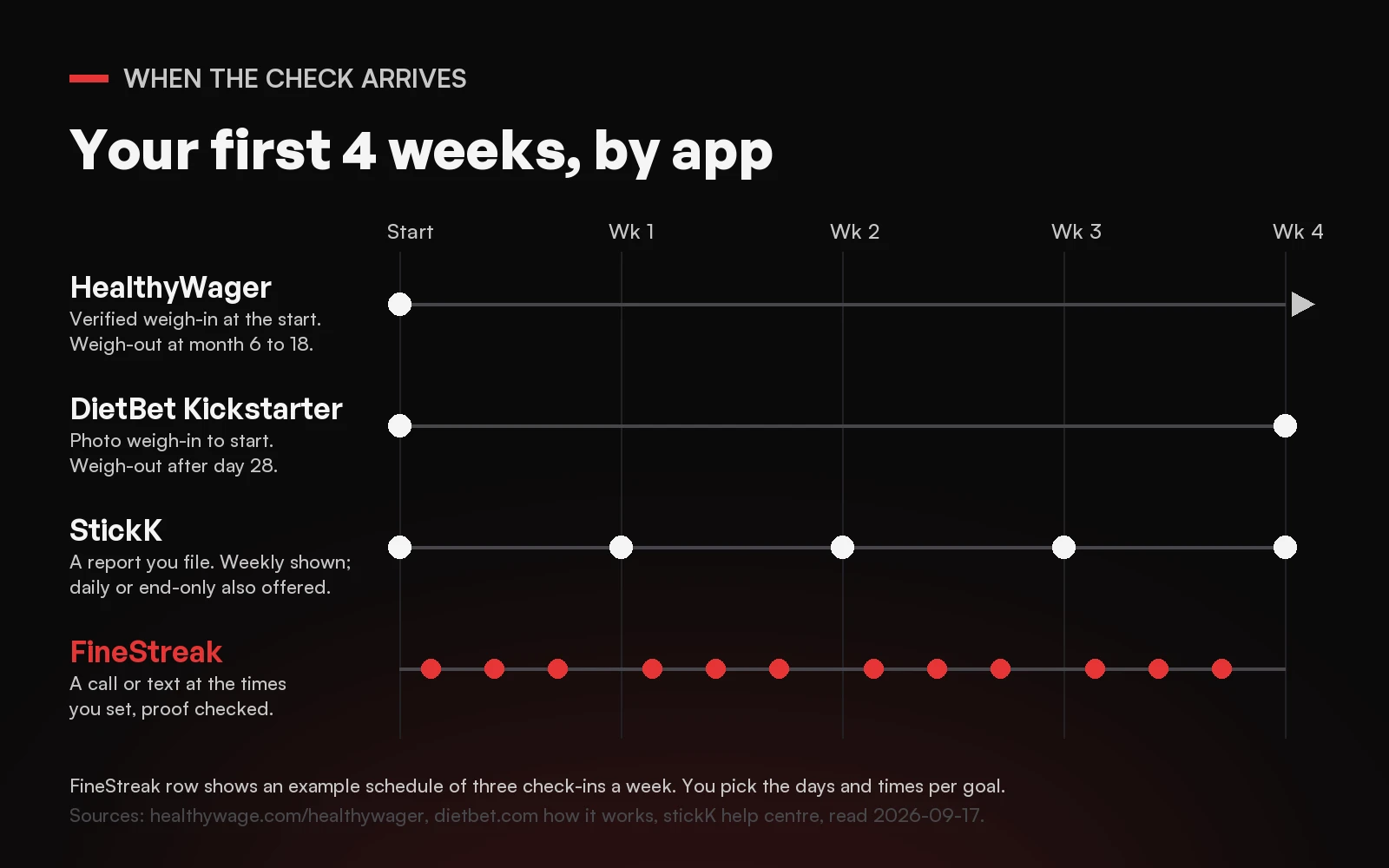
Timing is the question most weight loss app comparisons skip, and it decides whether an app helps on a Tuesday evening.
Weight is an outcome. It moves slowly and bounces for reasons unrelated to your effort, so an app that verifies the scale has to verify rarely. HealthyWage's HealthyWager FAQ says it verifies "your starting and ending weights with a simple at-home video", and the calculator sets a timeline of 6 to 18 months. Its how-it-works section also mentions weekly weigh-ins and support from other contestants along the way. DietBet's Kickstarter asks for two photos at the start, each "individually reviewed by a DietBet Referee", then gives you 28 days; weigh-ins during the game are self-reported and, in DietBet's words, "unofficial".
The decisions that move the scale happen at specific times: the 6 a.m. alarm, the lunch order, the moment you decide whether to change into gym clothes. A payout that resolves months away is abstract at those moments. Loss aversion works hardest on a loss that is close. So an outcome bet gives you a strong start and a strong finish, and a behavior check is what covers the days in between.
The 9 Weight Loss Accountability Apps Compared
| App | What checks you | How often | Money involved |
|---|---|---|---|
| HealthyWage | Verified video weigh-in | Start and end of a 6 to 18 month bet | Your bet, $5 to $995 a month; prizes up to $10,000 |
| DietBet | Photo weigh-in reviewed by a referee | Start and end of the game (Kickstarter: 28 days) | Kickstarter bet averages $35 |
| stickK | A Referee you choose, or yourself | Reports daily, weekly or at the end | Optional; free to create a contract |
| BetterTogether | Friends, family or colleagues in a group | Whenever the group checks the leaderboard | Free download, in-app purchases |
| Weight Loss Buddy | A community and buddies | Whenever you post | Free to join, optional paid AI features |
| WeightWatchers | Coaches in the app and in Workshops | Workshops, plus chat | Paid membership |
| Noom | Human coaching plus AI support | Daily lessons, plus coaching | Trial offered; no price on the homepage |
| MyFitnessPal | You | Whenever you log | Free account; Premium from $79.99 a year |
| FineStreak | An Agent that calls or texts, then checks proof | At the times you set for each goal | Plans $5 to $20 a month; fines optional |
1. HealthyWage: best for a large cash target
HealthyWage runs cash weight loss challenges and advertises prizes of up to $10,000. The HealthyWager is an individual bet: you enter how much you want to lose, a timeline of 6 to 18 months and a monthly bet from $5 to $995, and the calculator returns a prize range. Your starting and ending weights are verified with a short at-home video in the HealthyWage app, and the ending weigh-in can happen in the final two weeks of the challenge. The challenge list also carries shorter group formats, Fast Track challenges at 4 percent in a month and Jackpot challenges at 6 percent over three months, and you can join up to 10 challenges at once.
HealthyWage points to Volpp and colleagues' 2008 randomized trial in the Journal of the American Medical Association and says people who bet were up to five times more likely to hit their goal.
Good for: people who respond to a big, concrete number and a finish line. Weak spot: the verified checks sit at the start and the end, which can be up to 18 months apart.
2. DietBet: best for a short round with a group
DietBet players put money into a pot and the winners split it. The Kickstarter asks you to lose 4 percent of your body weight in 4 weeks, and DietBet lists the average bet at $35. The Transformer asks for 10 percent in 6 months, at $35 a month or $175 upfront. DietBet says it has paid $101,121,996 to winners.
The weigh-in is stricter than most: two photos, one of you on the scale and one of the readout beside a weigh-in word that acts as a timestamp, reviewed by a DietBet Referee. You can cancel within 7 days of the game start for a full refund.
Good for: people who want a fast, social result. Weak spot: between the opening and closing weigh-ins, the updates you post are unofficial, so nothing verifies a single day.
3. stickK: best for designing your own consequence
stickK describes itself on the App Store as created by behavioral economists from Yale University. You write a Commitment Contract with a goal and a timeline, and you can add money if you want to. If you fail, stickK sends that money to a friend, a charity or an anti-charity, an organization you oppose. You report progress daily, weekly or once at the end, and a Referee can verify your reports. stickK's help centre says Commitment Contracts are free to create and that a Referee can overturn a report you marked successful.
It is a general goal platform with a Weight Loss community, so the weight loss plan is yours to write. The anti-charity option is the part people remember.
Good for: people who want to set the consequence themselves. Weak spot: the reports come from you, so the check is only as strong as the Referee you pick. Our stickK alternatives guide covers the apps that verify more directly.
4. BetterTogether: best for a group of people you know
BetterTogether calls itself a social weight loss challenge app for friends and family. You create or join a group challenge, set group goals, and follow a leaderboard, a group chat and each other's progress on weight, steps, floors, water and BMI. It integrates with Apple's Health app. The App Store listing shows it as free with in-app purchases, offered as monthly, yearly or lifetime subscriptions.
Good for: people who will show up because their sister is watching. Weak spot: the accountability depends on the group staying engaged, and neither its site nor its listing describes a fine or a scheduled check-in.
5. Weight Loss Buddy: best for a community of strangers
Weight Loss Buddy is a community app: a home feed for progress updates and photos, buddies you connect with, groups built around shared goals (including one for people on GLP-1 medications), and an AI helper called Robi. Its listing says it is free to join, with optional premium AI features through an in-app subscription.
Good for: people who have no one at home doing this with them. Weak spot: the encouragement comes from the community feed, so it depends on you opening the app.
6. WeightWatchers: best for human support in a structured plan
WeightWatchers builds its program on Points and pairs it with coaches you can chat with in the app. Its coach-led Workshops run in studios and online, and the site claims members who attend lose two times more weight than those who do it themselves. It sells Core and Core+ memberships and a separate medication program. WeightWatchers states that participants in a clinical trial of its program lost an average of 12 lbs, 5.4 percent of body weight, after 6 months.
Good for: people who want a food system and a person to talk to. Weak spot: it costs a monthly membership, and the Workshops are optional, so the accountability is what you attend.
7. Noom: best for psychology-based lessons with coaching
Noom describes itself as psychology-based weight loss: bite-sized daily lessons, meal logging, water tracking and on-demand exercise classes, with "human coaching plus AI support" inside the app and a community through Noom Circles. It also runs Noom Med, a GLP-1 medication program. The homepage sends you to a trial or an eligibility check, so check the price there before you commit.
Good for: people who want to understand why they eat the way they do. Weak spot: it is a full program, which is more than you need if your plan is already clear and the problem is sticking to it.
8. MyFitnessPal: best for knowing what you actually eat
MyFitnessPal calls itself the world's number one nutrition tracking app, used by over 280 million people, with a database of 20.5 million foods. The free account tracks calories, weight, exercise and water. Premium adds Barcode Scan, the intermittent fasting tracker and custom macro goals at $79.99 a year, and Premium+ is $99.99 a year. It syncs with more than 40 apps and devices.
Good for: anyone who cannot say what they ate yesterday. A month of logging is the most useful data you will collect. Weak spot: it is a record you keep. If you stop opening it, the record simply stops.
9. FineStreak: best for a check that arrives on the day
FineStreak puts the check on the behavior. You set a goal, such as a 6 p.m. walk or a gym session, and choose the days and times you want to be checked; it does not have to be every day. At each of those times an Agent calls or texts you, and you reply with a photo, a screenshot or your location. Calls reach US numbers, and texts reach US and Canadian numbers.
The proof gets examined. A vision model matches the image against that specific goal, a re-sent photo gets blocked, the capture time is read from the file, and error-level analysis flags edited images. Fines are optional and off by default. They unlock at the Committed rank, and a member adds one to a goal on the FineStreak website, from $0.10 up to the rank's cap: $3 at Committed, rising to $50 at Legendary. On a goal with a fine set, a missed verified check-in charges that amount. The free week covers the calls and texts with no card, and it cannot enable fines. After that, plans run from $5 to $20 a month.
Good for: people who know what to do and keep not doing it at 6 p.m. Weak spot: it does not count calories or weigh you, and there is no human reviewing disputed proof. Pair it with a tracker if intake is your gap.
What Is the Best Free Weight Loss Accountability App?
BetterTogether is the best free weight loss accountability app if you have people to do it with, because its accountability comes from a group of friends, family or colleagues who see a shared leaderboard, and the download is free, with optional monthly, yearly or lifetime subscriptions. Weight Loss Buddy is the free pick if you do not: it is free to join, connects you with buddies and groups, and charges only for optional premium AI features. stickK is the free option with money attached, because creating a Commitment Contract costs nothing and you choose whether to add money that goes to a friend, a charity or an anti-charity if you fail. MyFitnessPal's free account covers calorie, weight, exercise and water logging, which is tracking more than accountability. All four depend on you opening the app or on another person noticing, so pick the one whose trigger you trust most on a bad week.
Can a Weight Loss Accountability Partner App Replace a Friend?
A weight loss accountability partner app can do the part of a partner's job that people fail at most often, which is showing up on schedule. A good human partner does two things: notices when you skip, and makes skipping uncomfortable. Friend-based apps such as BetterTogether keep the human and give them better visibility through a leaderboard and group chat, and stickK formalizes the role by letting you name a Referee who has the final word on your reports. Both still rely on that person paying attention on a busy week. An app that contacts you itself removes that dependency. FineStreak's Agent calls or texts at the time you set whether or not anyone else remembers, and it checks the photo you send against the goal. If you have a committed partner, use a friend app and let them do the job. If your partners keep drifting off, our guide to accountability apps for friends and our page on an app that calls you cover both routes.
Which One Should You Pick?
Start with one question: is your problem knowing, or doing?
If you cannot say roughly what you ate yesterday, the gap is information, and MyFitnessPal solves it. Log for a month before you spend money on anything else. If you want someone to teach you a system, WeightWatchers or Noom is the better spend.
If you already know what to do and keep not doing it, more information will not help. Pick by how far away you want the consequence:
- Months away, with a big prize: HealthyWage.
- Four weeks away, with a group: DietBet.
- Whenever you define it, with a Referee: stickK.
- Whenever your friends look: BetterTogether.
- Today, at the time you picked: FineStreak. If the gym is the thing you keep skipping, see apps that charge you for skipping the gym, and for workouts in general, accountability apps for working out.
Running two is reasonable. A tracker for intake and a scheduled check on the behavior solve different halves of the problem. If your goal turns out to be a habit more than a weight target, our best accountability apps comparison has the wider list.
What No App Can Verify
No app can confirm you ate at a deficit, and none of these claim to. A photo proves a gym visit, a walk or a plated meal. A verified weigh-in proves a number on one morning. The hundred small choices in between stay yours. What a well-timed check buys you is a higher cost of skipping at the moment you are deciding, which is a smaller promise than most of this category makes and the one that holds up.
If you want that check on the day, start your free week. Seven days, no card, with calls and texts at the times you choose and the proof checked each time.
A note on fines: they are optional. A member who wants one sets it up on the FineStreak website, and the FineStreak iPhone app leaves fines out entirely.
Frequently Asked Questions
What is the most successful weight loss app for accountability?▾
It depends on where you slip. HealthyWage and DietBet put your own money on a weight target and verify your weight at the start and the finish. WeightWatchers and Noom add human coaching inside a structured program. BetterTogether and Weight Loss Buddy give you a group that sees your progress. FineStreak calls or texts you at the check-in times you set and examines the photo you send back. Pick the one that reaches you at the moment you usually give up.
What is the best free weight loss accountability app?▾
BetterTogether and Weight Loss Buddy are both free to download, with optional paid subscriptions, and both build accountability from other people: a group challenge in BetterTogether, a wider community and buddies in Weight Loss Buddy. MyFitnessPal's free account covers calorie, weight, exercise and water logging. stickK lets you create a Commitment Contract for free and add money only if you want to. Free options track and encourage, and a scheduled call or text with checked proof is the part FineStreak adds.
Is there a weight loss accountability partner app?▾
Yes. BetterTogether is built around partners you already know: friends, family or colleagues join a group challenge, set group goals, and follow a leaderboard and group chat. stickK lets you name a Referee, and its app says the Referee has the final word on your progress reports. If you do not have a reliable partner, an app that contacts you itself fills the same role without depending on someone else remembering.
Do weight loss money challenges actually work?▾
The research behind them is real. HealthyWage cites a 2008 randomized trial in the Journal of the American Medical Association, by Volpp and colleagues, and says people who bet were up to five times more likely to hit their goal. The limit is timing: a HealthyWager bet runs 6 to 18 months, so the money is far from any single evening's decision. Pairing an outcome bet with a check on the daily behavior covers the gap.
What is the best fitness app for accountability?▾
For workouts, the best accountability comes from something that checks whether the session happened on the day. DietBet and HealthyWage check the scale, stickK checks a report you file, and group apps rely on your friends noticing. FineStreak checks a gym photo or location against that specific goal at the time you chose. Our guide to accountability apps for working out compares the fitness-specific options in more depth.

The gym does not care whether you show up.
FineStreak does. An Agent checks in at the time you picked and asks for proof you were there, with a fine attached if you want one. Free for 7 days, no card.
Start your free weekRelated Articles

10 Best Accountability Apps in 2026 (Tested and Ranked)
The 10 best accountability apps of 2026, ranked by real-consequence design. Which apps use fines, AI check-ins, and social pressure best.

App That Charges You for Skipping the Gym: Does It Work? (2026)
An app that charges you for skipping the gym fines your card when you miss a verified workout. See how it works, whether it helps, and what replaced GymPact.

Accountability App for Working Out: 7 Compared (2026)
Most workout accountability apps do nothing when you skip. Seven apps compared by what actually happens on a missed day, with prices read from each vendor today.

7 Best StickK Alternatives in 2026, Ranked by Bite
Want a StickK alternative with real teeth? Compare 7 commitment apps by verification, cost, and how hard each one is to ignore. Updated for 2026.