How to Stop Procrastinating: The Science-Backed Fix

To stop procrastinating, interrupt the avoidance loop with a 5-minute start, name the feeling driving the delay, and add a real consequence (financial, social, or scheduled) that triggers before resistance does. Procrastination is not a time management failure. It is an emotional regulation failure. Your brain avoids hard tasks to protect your mood right now, at the expense of your future self. The fix is not willpower. It is systems that interrupt the avoidance loop before it starts.
You have a deadline in three days. You know exactly what you need to do. You have the skills, the time, the tools. And instead of starting, you reorganize your desk. You check your email for the fourth time. You open YouTube "just for a minute." Two hours later, the guilt hits. You promise yourself you will start tomorrow with real focus.
Tomorrow comes. Same thing.
This is not a character flaw. About 20% of adults are chronic procrastinators (Steel, 2007, Psychological Bulletin), and among college students the numbers are staggering: 80 to 95% procrastinate to some degree, with roughly half doing it chronically. You are not broken. You are running a default program that nearly every human brain runs, one of several mental shortcuts that quietly sabotage your habits. The question is whether you understand it well enough to override it. The same logic underpins our piece on discipline vs motivation: the goal is not to feel like working, it is to make the not-working option more expensive.
Why Do You Procrastinate? (It Is Not Laziness)
The biggest misconception about procrastination is that it is about poor time management or a lack of discipline. Delaying one specific task you have already decided to do is a different problem from skipping the things nobody checks, which we take apart separately in how to stop being lazy. Tim Pychyl, one of the leading researchers in the field, puts it bluntly: procrastination is "not a time management problem, it's an emotion management problem."
When you sit down to work on something difficult, boring, or anxiety-producing, your brain registers a threat. Not a tiger. A feeling. The task triggers discomfort, whether that is fear of failure, overwhelm, perfectionism, or just plain boredom. Your brain, which is wired to prioritize immediate comfort, does what it has always done: it runs. When that pattern is constant rather than occasional, an app built around external consequences tends to hold better than a technique, which is the case we make in accountability apps for ADHD. That now-over-later pull is even stronger for people whose executive function runs differently, which is why accountability strategies built for ADHD lean on immediate, external consequences rather than distant rewards.
That running looks like scrolling, snacking, cleaning, or any of the hundred small diversions you use to escape the feeling. It works, too. For about five minutes.
Sirois and Pychyl's 2013 research, published in Social and Personality Psychology Compass, made this mechanism explicit. Procrastination is fundamentally a failure of emotional regulation. People do not avoid the task. They avoid the feeling the task creates. The avoidance provides brief mood repair, but it generates guilt, anxiety, and time pressure that make the task feel even worse the next time you face it. This is the same loop we cover in stress and habit reversion: when discomfort spikes, your brain falls back to whatever pattern relieves it fastest.
This is why telling a procrastinator to "just do it" is about as useful as telling someone with insomnia to "just sleep." The problem is not in the doing. It is in the feeling that precedes the doing.
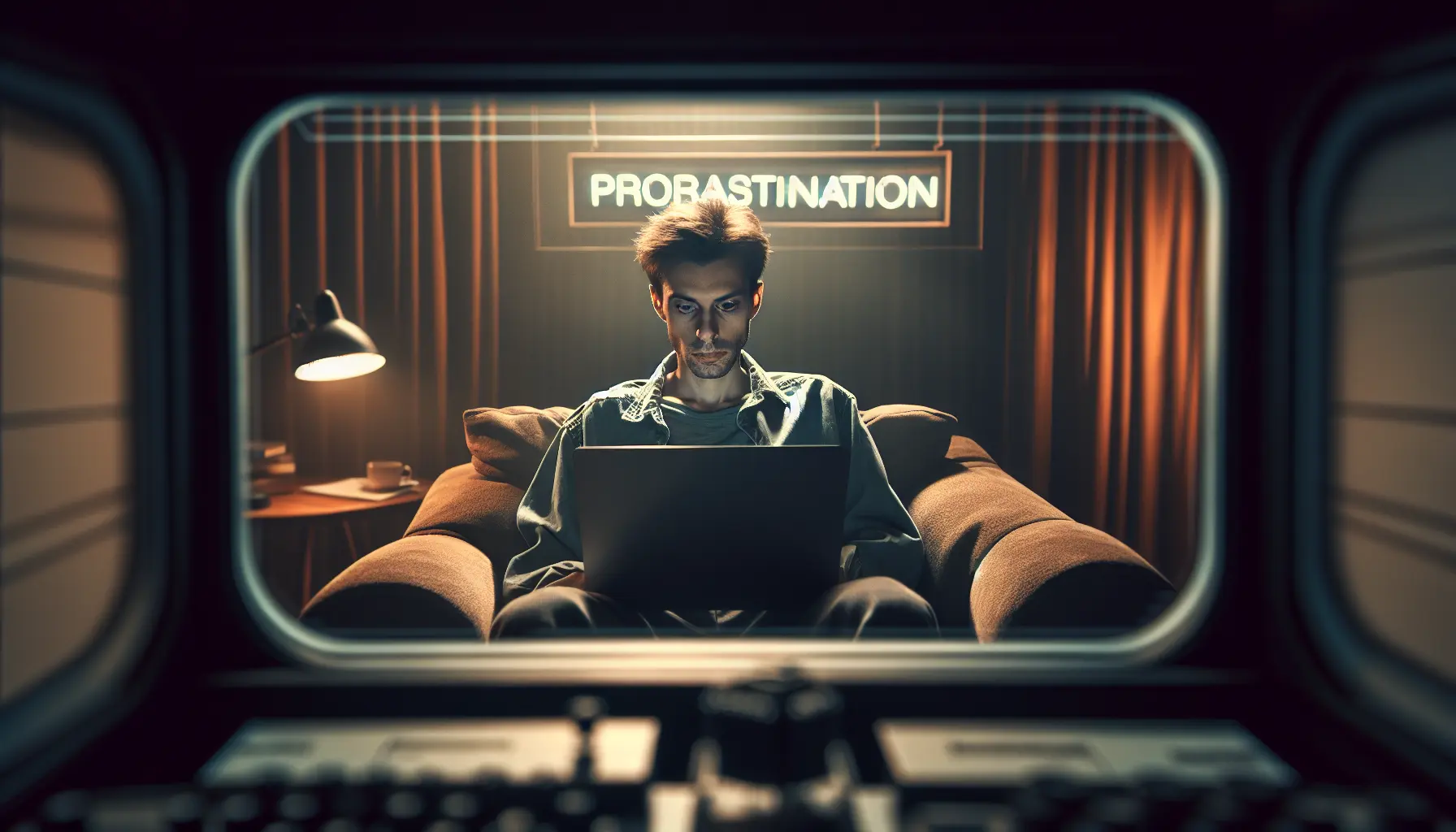
What Is the Emotion Loop That Keeps You Stuck?
Once you understand that procrastination is emotional, the cycle becomes visible. It runs on a loop, and every rotation makes the next one harder to break.
| Stage | What Happens | Result |
|---|---|---|
| 1. Trigger | Face an aversive task | Anxiety or dread activates |
| 2. Avoidance | Reach for phone, email, anything else | Short-term mood relief |
| 3. Guilt | Relief fades, guilt accumulates | Task feels even harder |
| 4. Escalation | Next avoidance episode is longer | Loop tightens |
| 5. Compounding | Cost builds across weeks and years | Real-world consequences |
Fuschia Sirois captured it precisely: "The effect of procrastination on repairing mood is short term and does not have long-lasting effects, whereas delaying goals imposes greater costs on the individual."
Those costs are not abstract. A US survey of 22,000 employees found that regular procrastinators reported lower annual incomes and less job stability. They entered the workforce later and earned less. Not because they lacked talent, but because delay compounded across years until the gap became a canyon.
The health data is worse. Chronic procrastination has been linked to cardiovascular disease, hypertension, headaches, digestive issues, insomnia, and weakened immune function. Longitudinal research tracked procrastinators for up to 18 years and found that the habit predicted negative outcomes across academic, workplace, relationship, and health domains. This is not a quirky personality trait. It is a pattern with measurable consequences.
There is a neurological twist that makes this feel rational. Brain imaging shows that when people think about their future self, they activate different neural regions than when thinking about their present self. Your brain treats "future you" like a stranger. So when you push a deadline to next week, you are handing the problem to someone your brain barely recognizes as you. The discomfort disappears. For now. It is the adult version of the trade-off in the marshmallow test, where the reward for waiting has to compete with a smaller one available right this second.
22,000 employees surveyed. Those who procrastinated regularly reported lower incomes, less job stability, and delayed career starts. The cost of avoidance is not just stress. It is money.
What Actually Works to Stop Procrastinating?
If procrastination is an emotion problem, then the solutions need to target emotions, not schedules. Buying a planner will not fix this. Color-coded calendars will not fix this. Strategies that work address the feeling that triggers avoidance.
Cognitive behavioral therapy has the strongest evidence. Randomized controlled trials by Rozental and colleagues found large effect sizes: d = 1.29 for internet-based CBT and d = 1.24 for group CBT. These are not small improvements. These are massive shifts. CBT works because it targets the distorted thoughts ("this has to be perfect," "I will fail anyway," "I am not in the right mood") that fuel avoidance. It also reduces the depression and anxiety that ride alongside chronic procrastination. Many of the core methods are CBT techniques you can use on yourself, no therapist required.
Not everyone needs a therapist. Several techniques drawn from CBT principles work in everyday practice.
Shrink the emotional size of the task. You are not avoiding a 40-page report. You are avoiding the feeling of sitting down to write one. Tell yourself you will work for five minutes. Just five. The resistance drops because five minutes does not trigger the same emotional alarm as "finish the whole thing." Most of the time, once you start, you keep going. The hardest part was the transition from avoidance to action.
If reaching for the phone is where most of your lost hours actually go, putting a cost on that specific habit works better than willpower, which is the case for an app that charges you for screen time.
Name the feeling. When you catch yourself reaching for your phone instead of starting, pause. Ask: what am I feeling right now? Boredom? Fear? Overwhelm? Research on affect labeling shows that simply naming an emotion reduces its intensity. You cannot regulate what you refuse to acknowledge.
Remove the decision point. Procrastination lives in the gap between "I should do this" and "I am doing this." Every second in that gap is an opportunity for your brain to talk you out of it. Reduce decisions. Set a specific time, a specific place, a specific first action. When 9 a.m. arrives, you open the document. No negotiation with yourself. The impulse control strategies that work for other behavioral challenges apply directly here.
Make the future self feel real. Write a letter from your future self. Visualize the version of you at the deadline who either started early or did not. Researchers have used age-progression software to make people save more for retirement, and it works. The more vivid your future self becomes, the harder it is to dump problems on them.
How Do You Build Systems That Prevent Procrastination?
Individual tactics help. Systems prevent. The difference is that a tactic requires you to remember and choose. A system runs whether you feel like it or not.
Commitment devices are one of the most reliable tools in behavioral science. A commitment device is anything that locks in future behavior before the emotional resistance shows up. You tell a friend you will send them your draft by Friday, and if you do not, you owe them dinner. You put money on the line. You schedule a meeting where you will present progress. The research is covered in depth in our piece on commitment devices that work and what is a commitment contract, but the short version: adding a real cost to delay dramatically reduces it. For the underlying economics, see do financial penalties change behavior.
Environment design matters more than most people realize. If your phone is on your desk, you will pick it up. That is not weakness. That is how attention works. Put it in another room. Use website blockers during work hours. If the phone is your main source of friction, digital minimalism takes this to its logical end. Arrange your workspace so the first thing you see is the task, not the escape. The willpower depletion myth is worth understanding here, because the old idea that you have a finite tank of willpower has been largely debunked. What actually drains you is constant decision-making, not effort itself. Simplify the environment and you simplify the decision.
Accountability structures close the loop. A study, a plan, a blocker: all of those can be ignored when nobody is watching. Accountability adds a human element that makes avoidance socially costly. Even telling another person what you plan to accomplish today increases follow-through, and simply working alongside someone else through body doubling can pull you into the task without a word being exchanged. The mechanism is loss aversion: you work harder to avoid admitting you did not follow through than you will to earn a vague future reward. If the work in question is coursework, we compared the accountability apps built for students by which part of that loop each one closes.
Scheduled interruptions are the highest-yield system. Procrastination is passive. You drift into it without deciding to. A daily check-in, a standing meeting, or a call at a set time pulls you out of drift and forces honest assessment. Did you do what you said? Yes or no. No story. Just the answer. The very first delay of the day is hitting snooze, which is why apps that call you to wake up interrupt that drift at the moment it starts, before the day's procrastination has a chance to compound.
How FineStreak Approaches This
Most productivity tools solve for the wrong layer. They give you better lists, better calendars, better reminders. But a reminder is easy to dismiss. A notification is easy to swipe away. Your brain has been practicing avoidance for years.
FineStreak is an accountability app that uses real fines and check-ins on the schedule you set to help people build lasting habits. Every day, at a time you choose, you get an AI phone call. Not a notification. Not a text. A call. It asks you what you committed to. It asks you whether you did it. And if you did not, there are real financial consequences. The mechanism is detailed in our science of accountability check-ins breakdown.
If the task you avoid is reliably the writing, the tools built for that specific avoidance are worth reading before you pick a general one. The scheduled call interrupts the avoidance loop before it has time to build. The voice interaction makes it harder to lie to yourself. The financial penalty activates loss aversion, the same force that makes procrastinators delay in the first place, but pointed in the opposite direction.
You do not need more motivation or a new app with better colors. You need a system that shows up whether you feel like it or not, asks the hard question, and makes avoidance more expensive than action.
That is what FineStreak does. If you are working on other habit challenges alongside procrastination, the self-discipline guide covers the full system.
A note on fines: they are optional. A member who wants one sets it up on the FineStreak website, and the FineStreak iPhone app leaves fines out entirely.
Frequently Asked Questions
Is procrastination just laziness?▾
No. Research by Sirois and Pychyl shows procrastination is a failure of emotional regulation, not effort or time management. People delay tasks to escape negative emotions like anxiety and boredom, not because they are unwilling to work.
Can procrastination actually affect your health?▾
Yes. Chronic procrastination has been linked to cardiovascular disease, hypertension, insomnia, and weakened immune function. Longitudinal research found that procrastination predicted negative health outcomes up to 18 years later.
What is the most effective treatment for procrastination?▾
Cognitive behavioral therapy has the strongest evidence, with large effect sizes in randomized controlled trials (d = 1.29). Structured accountability and breaking tasks into smaller emotional units also show strong results.
Why do I procrastinate even on things I want to do?▾
Because your brain treats your future self like a stranger. Brain imaging shows people use different neural regions when thinking about their future versus present self, making the consequences of delay feel abstract and distant.
Does accountability help with procrastination?▾
Significantly. External accountability interrupts the avoidance loop by adding a social or financial cost to delay. Commitment devices and scheduled check-ins reduce the emotional gap between intention and action.
What is the two-minute rule for procrastination?▾
If a task takes less than two minutes, do it now. For larger tasks, commit to working for just five minutes. Research shows starting is the hardest part; once you begin, momentum carries you forward through the emotional resistance.

The task you have moved to tomorrow four times.
Put a real check-in on it. An Agent contacts you at the time you set, asks for evidence, and charges the fine you picked if you added one. Free for 7 days, no card.
Give it a deadline that answers backRelated Articles

How to Build Self-Discipline: A Research-Backed Guide (2026)
Build self-discipline with research-backed systems. See why willpower fails, what the Dunedin Study proves, and how real consequences triple follow-through.

Discipline vs Motivation: Why One Always Wins
Discipline beats motivation every time. See the Stanford research, why willpower fails, and the 3 systems that work when you don't feel like it.

How to Stop Being Lazy: Change What Skipping Costs You
Most advice treats laziness as a mood to manage. Here is the structural cause, how to tell it apart from burnout, depression or ADHD, and what to change first.
Self-Discipline Research: 10 Studies and What Still Holds Up (2026)
10 landmark self-discipline studies reviewed with modern replications. What held up, what got debunked, and what it means for building your daily habits.